

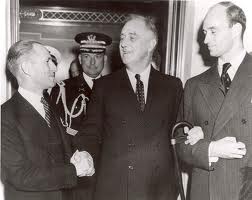
The Great Depression lasted from the stock market crash in 1929 until World War 2. In the middle of this economic crisis, President Franklin Delano Roosevelt appointed Utahn Marriner Eccles to become the Fed Chair. Robert Reich has high praise for Eccles in his latest book Aftershock, even going so far as to rate both Paul Volcker and Alan Greenspan as “no Marriner Eccles.” Frankly, I was astonished at Reich’s praise for Eccles throughout the book. From chapter 1 to the end of the book, Reich repeatedly referred to Eccles. On page 11, Reich gives a bit of background on Eccles,
While Eccles is largely forgotten today, he offered critical insight into the great pendulum of American capitalism. His analysis of the underlying economic stresses of the Great Depression is extraordinary, even eerily, relevant to the Crash of 2008. It also offers, if not a blueprint for the future, at least a suggestion of what to expect in the coming years.
A small, slender man with dark eyes and a pale, sharp face, Eccles was born in Logan, Utah, in 1890. His father, David Eccles, a poor Mormon immigrant from Glasgow, Scotland, had come to Utah, married two women, became a businessman, and made a fortune. Young Marriner, one of David’s twenty-one children, trudged off to Scotland at the start of 1910 as a Mormon missionary but returned home two years later to become a bank president. By age twenty-four he was a millionaire; by forty he was a tycoon–director of railroad, hotel, and insurance companies; head of a bank holding company controlling twenty-six banks; and president of lumber, milk, sugar, and construction companies spanning the Rockies to the Sierra Nevadas.
In the Crash of 1929, his businesses were sufficiently diverse and his banks adequately capitalized that he stayed afloat financially. But he was deeply shaken when his assumptions that the economy would quickly return to normal was, as we know, proved incorrect. ‘Men I respected assured me that the economic crisis was only temporary,’ he wrote, ‘and that soon all the things that had pulled the country out of previous depressions would operate to that same end once again. But weeks turned to months. The months turned to a year or more. Instead of easing, the economic crisis worsened.’ He himself had come to realize by late 1930 that something was profoundly wrong,”
…
When Eccles’s anxious bank depositors began demanding their money, he called in loans and reduced credit in order to shore up the banks’ reserves. But the reduced lending caused further economic harm. Small businesses couldn’t get the loans they needed to stay alive. In spite of his actions, Eccles had nagging concerns that by tightening credit instead of easing it, he and other bankers were saving their banks at the expense of community–in “seeking individual salvation, we were contributing to collective ruin.”
Doesn’t this sound familiar to our current day? Reich notes that the reaction of the day by leading economists and business leaders (from page 13) was that,
government’s only responsibility was to balance the federal budget. Lower prices and interest rates, they said, would inevitably “lure ‘natural new investment’ by men who still had money and credit and whose revived activity would produce an upswing in the economy.” Entrepreneurs would put their money into new technologies that would lead the way to prosperity. But Eccles wondered why anyone would invest when the economy was so severely disabled. Such investments, he reasoned “take place in a climate of high prosperity, when the purchasing power of the masses increases their demands for a higher standard of living and enables them to purchase more than their bare wants. In the America of the thirties what hope was there for developments on the technological frontier when millions of our people hadn’t enough purchasing power for even their barest needs?”
From page 14,
Eccles also saw that “men with great economic power had an undue influence in making the rules of the economic game, in shaping the actions of government that enforced those rules, and in conditioning the attitude that enforced those rules, and in conditioning the attitude taken by people as a whole toward those rules. After I had lost faith in my business heroes, I concluded that I and everyone else had an equal right to share in the process by which economic rules are made and changed.” One of the country’s most powerful economic leaders concluded that the economic game was not being played on a level field. It was tilted in favor of those with the most wealth and power.
Eccles called for a change in the economy. Rather than catering to the whims of the richest, he said the economy needed to help all Americans. Balancing the budget was the wrong remedy, because it would help the rich at the expense of all Americans. Three years prior to famed economist John Maynard Kenyes, Eccles proposed (from page 14)
that the government had to go deeper into debt in order to offset the lack of spending by consumers and businesses. Eccles went further. He advised the senators on ways to get more money into the hands of the beleaguered middle class. He offered a precise program designed to “bring about, by Government action, an increase in the purchasing power on the part of all people.”
From page 15,
His proposed program included relief for the unemployed, government spending on public works, government refinancing of mortgages, a federal minimum wage, federally supported old-age provisions, and higher income taxes and inheritance taxes on the wealthy in order to control capital accumulations and avoid excessive speculation. Not until these recommendations were implemented, Eccles warned, could the economy be fully restored.
It was a tough sell. Roosevelt had campaigned on balancing the budget. From page 16,
Roosevelt’s budget of 1934 contained many of Eccles’s ideas, violating the president’s previous promise to balance the budget. The president “swallowed the violation with considerable difficulty,” Eccles wrote.
The following summer, after the governor of the Federal Reserve Board unexpectedly resigned, Morgenthau recommended Eccles for the job. Eccles had not thought about the Fed as a vehicle for advancing his ideas. But a few weeks later, when the president summoned him to the White House to ask if he’d be interested, Eccles told Roosevelt he’d take the job if the Federal Reserve in Washington had more power over the supply of money, and the New York Fed (dominated by Wall Street bankers) less. Eccles knew that Wall Street wanted a tight money supply and correspondingly high interest rates, but the Main Streets in America–the real economy–needed a loose money supply and low rates. Roosevelt agreed to support new legislation that would tip the scales toward Main Street. Eccles took over the Fed.
For the next fourteen years, with great vigor and continuing vigilance for the welfare of average people, Eccles helped steer the economy through the remainder of the Depression and through World War II. He would also become one of the architects of the Great Prosperity that the nation and much of the rest of the world enjoyed after the war.
Eccles retired in Utah in 1950 to write his memoirs and reflect on what had caused the largest economic trauma ever to have gripped america, the Great Depression. Its major cause, he concluded, had nothing whatever to do with excessive spending during the 1920s. It was, rather, the vast accumulation of income in the hands of the wealthiest people in the nation, which siphoned purchasing power away from most of the rest.
 Reich goes on to show 2 very important graphs outlining the problem. In Figure 1, (page 21) he shows an interesting phenomena. During the 2 greatest crashes in stock market history, 1929, and 2007, the richest 1% of the nation (those that make above $398,9000 in 2007), accounted for nearly 25% of the wealth of the nation. You can see this in the graph at the right because the 2 ends are at the highest points. The rich are becoming rich at the expense of the poor.
During the trough of this (roughly from 1938-1983), the U.S. economy was under what Reich calls “the Great Prosperity. Looking at a second graph, we see an interesting phenomenon. From 1947-1974, productivity and wages matched. After 1974, wages stagnated even though productivity increased. The gap in income for workers went to the richest 1% of Americans. If we want to fix the economy, this gap must close.
 Reich has some very interesting, counter-intuitive proposals that I will discuss in a future post. His main idea is to quit squeezing the middle class. He says the rich are getting rich at the expense of the middle class. He says that the problem with America currently is not jobs, it is pay. If we can fix this disparity, the economy will be better for both the rich, the poor, and the middle class. What do you think about these ideas so far?
 Wheat & Tares
that darn socialist/commie!!!
of course, he was correct, and we’re profoundly dumb as a nation to allow ourselves to fall back into the same bad habits of allowing the rich to take our money, and even let them think it is theirs.
Great stuff. There’s a reason Marriner’s name is on the Fed building. We didn’t lose faith in our ability to see a return on investment in our human resources overnight. Here’s to hoping we’re sufficiently cognizant and confident enough in the lessons of our own recent past to bet on our fellow citizens again.
in light of the recent comments at general conference lauding president grant and the welfare system (a product of the depression) does anyone else find it surprising that mormons don’t talk at all about marriner eccles?
Sounds like Marriner Eccles was a fulfillment of the White Horse Prophesy to save us from financial disaster 😉
In my (studied) opinion, Robert Reich is more of a partisan hack than a historian or competent economist, so as soon as I read “Robert Reich” I filed this under Fiction, commented, and moved on.
that’s like saying Milton Friedman was a partisan hack…
N: if it really was a studied opinion, you’d have more to say on the matter — and you’d be willing to say it nonymously.
The problem with the “government spending to get us out of a business cycle” is that it eventually catches up with you – actually, it has caught up with us to the tune of 14 trillion dollars. A financial situation that cannot be fixed – it is six times our current income.
Business cycles have been a part of society since the beginning of time; and, the solution, was revealed to Joseph in Egypt – save in the good years so you are prepared for the bad years. God didn’t say have the Government spend like it is someone else’s money. God’s plan is simple — save money to plan for the down-turns.
Balance the Damn budget and quit spending money we don’t have.
Will,
Bullcrap. The US government ran up a massive debt both to stimulate the economy in the 1930s and to fund its activities in World War II. And guess what? Through high taxes and a thriving economy, the US government received enough income to reduce that deficit to a low of $900 million in 1979. Then some idiot actor came to power and tripled that debt. Suddenly it was $2.7 trillion. Then his Vice President added a few hundred billion more. Then Clinton added a few hundred billion more (less, I might add, than what Bush Senior added in his four years). And then Bush Junior added another $5 billion!
We can fix that. Raise taxes back to proper levels (50% on the top 1%—income earners over $450,000; 60% on those earning over $1,000,000).
For comparison sake, the recent kerfuffle over a measly $38 billion cut from the budget…if we but eliminate the Bush tax cuts, that brings back $200 billion revenue into the state coffers.
But for those on the right, they’ve never actually cared about the deficit. They just don’t want Democrats in charge, and they’ll say and do anything to get Democrats out. What a bunch of pansy losers.
You say that during a “bad year” or a “downturn.” Where were you to say that to Bush? Why did you vote for Bush in 2004? Silly Republicans…
Will: Balance the Damn budget and quit spending money we don’t have.
I agree with you very much in theory, but the devil is in the details.
I was in Washington DC last week in various Senators and Representatives’ offices, and no one has any clue what to do. And they’ll admit it. They have principles, like the statement you just said, but have not clue on implementation.
Take health care, for example. Medicare is broken and underfunded. Medicaid is woefully underfunded. As a doctor, it costs me around $30/new patient in case I get sued at some point in their care. For a Medicaid patient, I get around $30-40. So, by the time I include rent, my staff, insurance, supplies, etc., I lose money seeing Medicaid patients. Because of this, it’s really hard to find a doctor who will actually see a Medicaid patient.
For Medicare, even though costs have gone up 30-40% over the past decade to run a practice (like everything else), a surgeon gets the exact same amount for a hip or knee replacement.
Now, no doctor is under the delusion that they are going to make more in the future. Things will be cut. But if they’re cut much more, doctors simply won’t be able to afford to see patients. The costs of running a practice will exceed the money a practice brings in. And they’ll just retire.
So what do you do? Raise taxes to get more money into the system. Pay less to the healthcare system. Or do you start to ration care?
Do we stop paying $50,000 for a breast cancer drug that extends life, on average, by 2 months? How about if that was your wife, with 3 small children? What if there was a 5% chance it would work on your wife and cure her so she could see your kids grow up and a 95% chance it wouldn’t make any difference? Would you at least want to give it a shot? Or would you stick to your guns and quite spending money we don’t have?
Or how about your father who is over 60 and has kidney failure. Should we give him dialysis? Or should we just let him die as other countries do?
Or how about your grandmother with some dementia who broke her hip? Do we spend $40,000 fixing it, knowing that there is a 75% chance she will be dead in a year anyway? Or do we just give her some morphine for comfort and let her get a pneumonia and die in the next 2 weeks?
Could you imagine any congressman actually proposing any of these things? They’d be slaughtered in the next election. You can already see the ads.
And this is just medicine. The majority of programs exist to help SOMEONE. Something for the poor. Something for the blind. Something for the disabled. Something for the vet’s family who sacrificed his life so I could sit here writing this. Which of these do you want to cut?
And if we cut it, who is going to pick up the slack. Are you going to pay for your neighbors diabetes medicines? Is the Church going to pay for any of the the trillions cut with the billions in tithing revenue? Or do we just let people languish?
So, I agree absolutely with you that something needs to be done. All of Washington DC also agrees with you, to be honest. But no one knows what to do.
sorry Bush Junior added $5 TRILLION, not billion.
reich notes that the top tax bracket under republican president eisenhower was about 90%, and these were the good ole years of the 1950’s, when the economy really took off.
I know it is not even a thought by tea partiers, but if you will want a balanced budget, then raise the damn taxes of the top 1% of earners and see what that does for the budget deficit.
Dan,
Bullcrap?
The way to wealth is to spend less money than you make and wisely invest the difference. On the other hand, the way to financial disaster is to spend more than you make and finance the difference. This formula for success of spending less than you make and investing the difference is an eternal principle. It applies to an individual, a family, a community, a church, a state or a nation. It works to matter what. It is an eternal principle established by God. It has always existed. It was irrevocably decreed before the foundation of the world with applicable punishment for disobedience.
As a nation, we have spent more than we bring in and are now reaping the consequences of our choices. Unfortunately, it will impact those that are dependent on the government the most. When, not if, but when it crashes the makers will still be the makers; and the takers will have nothing to take.
We are not the wealthiest nation on earth. We are broke and the current administration is going to bury us and crash the system with the reckless spending.
Will, Brigham Young decried profiteering. While I admit that Bill Gates and Warren Buffet are brilliant men, are you trying to tell me that they aren’t profiteers?
If tea partiers want me to give them any respect, then I ask them to put their money where their mouth is. If the balanced budget is so damn important, then raise taxes AND cut spending simultaneously. Cutting programs that help the poor only benefits the rich. If you’re going to cut social programs, then raise taxes. You’ll get a balanced budget much faster that way. Everybody needs to share the pain, not just the poor.
Here is Oz after the global downturn our Government invested in the populace. They sent out a one off payment to every household of about $900. They created building programs that provided jobs in a fragile industry at the time. And while there has been a lot of bleating about deficits and bringing the budget back into surplus the bootom line is we didn’t really lose too much momentum. We had an influx of million of dollars into the local economy thanks to Mum and Dad who spent their windfall on their households and ploughed it back into businesses. Our economy is robust, unemployment is stable and our dollar is trading nicely, thank you very much.
We’re not the wealthiest nation on the planet?!?!?! wow…Will really hates America…meaning that he really thinks very poorly of this country and its capabilities and characteristics. Will, dude, America IS the wealthiest nation on the planet.
Dan,
Do we have the largest GDP?
Yes, by quite a bit. Our GDP is larger that China, Japan and Germany (next three) combined; or 5-11 (France, UK, Italy, Brazil, Canada, Russia and India) combined; or the sum total of the bottom countries combined.
Do we have the extremely good international companies?
Yes, we have 536 of the top 2000 companies in the world. In spite of the efforts of the left to destroy business in this country, we have some good companies that create American jobs.
Wealth is measured in net worth, not total production or the number of good job creating companies. However, spend happy, fiscally liberal (mostly on the left), politicians have bankrupted this country. They have created more debt than we can pay back – 14 trillion in general obligation debt; and, another estimated 40 trillion on un-funded retirement and medical benefits. We are broke.
Thanks to the left we are no longer the wealthiest country in the world. Maybe that is their plan.
Will,
Who created that debt again? Ronald Reagan and George Bush with their massive increases in the size of the government increased the debt between the two of them 8 TRILLION dollars! Stop blaming the left when your idiots on the right are the ones who have done the most fiscal damage. The two presidents who spoke most about small governments are the two who gave us the greatest debt.
I love it when conservatives start acting like national finances should be governed by the same principles as personal finances. This is a smokescreen, pure and simple. Running the federal government like a spendthrift family would be a disaster.
Also, as this post shows, taxes on the top 1% are currently a disaster and arguable immoral. The top 1% are those that are doing the best by the system, they should pay more to operate in it. A high marginal tax rate encourages tycoons to plough money back into their companies in the form of wages and hiring rather than take it for themselves.
will, we need to work both sides of the equation if we want a balanced budget. when will you admit that raising taxes is prudent and necessary to balance the budget? are you against raising taxes for the top 1% of americans, who have more money than they can possibly spend?
We can argue about carry-over from previous administrations, etc., but the fact is our budget was largely balanced when Clinton was president.
Bush took us to war (twice) and thrashed our budget. He cost us trillions.
MH,
I spend a lot of my time around those in the 1% bracket; most of them real property investors. I am surrounded by it. Three of my brothers and brother in law are part of this group. First off, it is their money. They earned it and it should be their decision on what to do with it and how to invest it. Secondly, and most importantly, they are far better at making decisions then government bureaucrats – one group has made millions by their own ingenuity; while, the other has gotten us 14 trillion in debt spending other people’s money.
The real question is would you rather have the money in the hands of the government who is going to squander it (e.g. paying people to buy cars with Cash for Clunkers); or, in the hands of someone who is going to invest it and create jobs?
will, you are defending profiteers. you should be ashamed. the top 1% could pay more taxes, balance the budget, and keep social safety nets in tact. you are greedy.
so tell me, when one of your investing friends earns property for flipping it, or investing it, is that a more noble job than the walmart employee making $7 per hour who can’t afford health insurance?
ah yes, let’s put our trust in these bastards:
Sounds like they are looking out for my well being. These are your buddies, Will. These are your top 1%. They’re only looking out for their own frakking hides. And so do you. So I’m going to band together with the vast majority (i.e. 99%) who don’t make as much as the top 1%, and we’re going to tax the hell out of the top 1% until they stop being such greedy frakking bastards. Or they go Galt. Either way, works out for the rest of us just fine.
More from that link:
Ah, who better to trust my money to than the one who will not tell me of the fees he has laid in store for me.
MH,
Why would anyone invest in something if they are not going to make a return on their investment? The Church for example, invested one billion dollars in downtown Salt Lake City. They will make a return on their investment. They will make a profit, is that wrong? They also own other profitable businesses – retail, farming, ranching, canning, trucking, media, bottling companies, real property investment, etc.. They are one of the largest property holders in Hawaii, Florida, Idaho and Utah. Are they wrong? Personally, I think they single handily saved the economy in Utah over the past three years. They pumped a billion in construction and investment. Should they bury their talents? If those who have money (the Church included) don’t invest in the economy, who will?
My objective is to make as much money as I can, so I can spend as much time with my family as possible. I will profit as much as I can on every deal I make and I don’t see a problem with that at all.
“so tell me, when one of your investing friends earns property (I assume you mean profit) for flipping it, or investing it, is that a more noble job than the walmart employee making $7 per hour who can’t afford health insurance?”
Yes
will, remember what jesus said. it is easier for a camel to go through the eye of a needle than for a rich man to enter into heaven.
Remind me to avoid doing any business with you should we ever cross paths. It should be noted, that the guys down at Enron, or WorldCom, or any of the Wall Street banks out there, all agree with you, Will. You take that as a badge of honor.
First, it’s at least $3 billion they’re spending. Second, is their spending of money synonymous with the word “talent” as you use it? Third, regardless of how you answer my second point, it should be noted that they aren’t spending their money. They are spending our money and, at least as the scriptures describe, that money is not to be mixed between God and Mammon, but rather to help the poor, the widowed, the fatherless, the needy. Same goes with your money (Luke 12).
Until we fully understand the law of the tithe as contained in the scriptures, we’ll continue to dabble in real estate, ranches, bottling, investments, and on and on… and we’ll never, ever approach Zion.
What you’re professing here is the Gospel of Prosperity. Nothing more, nothing less. And it’s the same gospel that King Noah and his priests professed to follow (M0siah 12:15).
MH,
Most of the 12, and First Presidency, are wealthy. Does that apply to them? The Savior used various Hyperbole’s, including that one. Some have denoted other meanings such as the eye of the needle was an architectural feature or 4’ high Arch and the Camel would need to remove its baggage, get down on it’s knees and be lead through the needle by its master. Others suggest a translation error. The Aramaic word for Camel is the same as the word for Rope. Thus, some say the Savior was using the term rope in the context of a Hyperbole, which is what I think. In any case, a good share of the leaders of this church are wealthy – first presidency, 12, 70’s, Stake Presidents, Bishops, etc.. I would not make an unrighteous judgment against them as some of them do a great deal of good with their money.
But, answer the question. If the Rich don’t invest in the economy, who will?
I love the idea to “tax the hell out of the top 1%”. Seriously? That sounds great, but how about what will really happen if you do that.
I don’t know my percentage, but I’m probably close. I went to 5 years of college. I went to 4 years of medical school. I went to 5 more years of residency. I went to another year of fellowship. During this time, I borrowed six figures. I was in the hospital 100-120 hours per week for years on end (before the new rules) with a maximum time of 156 hours one week. And yes, I was only home one night for 6 hours and one night for 7 hours. I have taken call. I have missed Thanksgiving dinner taking care of infections. Etc. And now, after all that, I am rewarded with a job where I am paid well.
And the answer to the problem is to “tax the hell” out of me? It won’t work. If the rate for the top tax bracket is raised to 70% or 90% as various proposals suggest, and if I pay 10% tithing as others suggest, I’ll just stop working past a certain point, as it won’t make any sense to work if someone is going to take it away anyway.
My wait times for patients will increase from 1-2 weeks up to 1-2 months. If you have a problem that seems urgent to you, I won’t have any reason to squeeze you in and see “just one more patient”.
I will go home earlier. I will have more lunches with my wife. I will ride my bike more and get in better shape. So, perhaps you proposal isn’t half bad. But it’s NOT going to fix the problem.
You cannot fix our country’s problems on the backs of 1% of the population. That 1% will either find some loophole or will just cut back and make the whole thing a smaller pie.
And before I’m seen as just another “greedy doctor”, don’t jump to conclusions. If you’ve seen any of my posts on here, I tend to the liberal side. I give A LOT of money to the Church. I give A LOT of money to various people in my ward and neighborhood who are having hard times. I give more than $100,000 away each year in free care to people who can’t pay. I see Medicaid patients for whom I lose money for every single one. But when it’s taken away from me, I won’t be able to do that. And I highly doubt the government will be an efficient distribution method for it.
So, suggest what you will. It’s a free country and we are all entitled to our opinion. But it is a bit short-sighted to suggest “taxing the hell” out of me.
David,
The last contract I saw was for $998 million. I was unaware of the 3 Billion mark, but, good for them. They are creating jobs, which is the best social program. It is far better to create jobs than social programs. Creating jobs is feeding the poor and clothing the naked. One promotes dignity and self respect and the other robs it.
#27: Will
It is absolutely NOT directed at you, but this is a pathetic comment. I think EVERYONE has a valuable role in society. I think EVERYONE is noble.
The amount of money someone makes says NOTHING about how noble they are. I know a lot of rich people who are bad people. I know a lot of poor people who are some of the happiest and most Christlike people I know. To even suggest that someone is more or less noble than someone else by how much they get paid is really sad.
Mike,
Outstanding! As usual, you put it better than anyone. Thanks
Mike,
# 33, I agree.
Look at the postion, not the person. One job creates jobs and the other does not. Thus, one is more noble than the other.
#35 Will
I don’t know. If I was hungry, I would think the person making my food was more “noble” than some banker who made some money on a short sale.
My best of piece of advice in my entire medical training came from a wise man my second year of medical school. He told me: “EVERY patient has something they can teach you. Find out what this is, and learn something from every patient.”
I do this today, almost 2 decades later. I have learned about driving semi-trucks down snowy canyons from drivers. I have learned how they bend glass for neon lights. I have gone to clubs to watch bands in which my patients play. I have learned about diagnosing car problems from mechanics. I have learned how to balance on a roof from a roofer.
I have been greatly enriched by my patients. To say that I am somehow more “noble” than my patients because I make more money than them, or because I employ people and create jobs is wrong. I have a job to do. So do they. And at the end of it all, we all die and take the exact same things with us.
Mike s.,
#31,
The top 1% earners in America are paid over $450,000 a year.
Sounds fine with me.
I highly doubt you get paid $450,000 a year as a doctor.
Mike,
Mike,
You are missing the point. Again, I am not comparing persons, but professions and what they do for the overall economy. Some professions create wealth and some do not. MH’s question was ‘…..is that a nobler job….” Yes, some jobs are nobler than others. Some contribute more to the overall economy.
A person, however, that works at the Wal-
mart could be nobler than the wealthiest man on earth. One may inherit the Kingdom of God and the other may not.
Dan,
“Sounds fine with me. ”
So with less revenue, less social programs. Is that what you are saying.
Will,
Again, sounds fine with me.
These people are going to heaven. 🙂
To quote Margaret Thatcher: “The problem with socialism is that you eventually run out of other people’s money.”
Mike S.,
Thankfully we’re not talking about socialism.
Will, I find your profiteering comment #26 especially repugnant. You may be a wise investor, but you’re morally bankrupt when it comes to money. Please tell me something. If you lived in the time of Brigham Young, would you have lived the United Order, giving all your funds to the church so they could distribute them to the poor? Would you follow Jesus advice to the rich man, and give all of your possessions to come follow him?
Will:
I’m not sure if you’ve looked at the definition of “noble” lately, but what you’re arguing is largely incongruent with the word itself.
To suggest that the only “noble” jobs, even accepting your definition, are those that create wealth is ridiculous. By your definition, the land baron, the Fed, Goldman Sachs, the bankers who make interest off my money, porn kings, drug lords, pimps, and anyone else that “creates” wealth is in a “noble” position, while the teacher, the garbage man, the janitor, the baker and anyone else not rolling in the dough [pun intended] is less noble.
Likewise, you said if “one creates jobs”, it is more noble. To that end, you’re merely mimicking the aristocratic origin of the word “noble.”
Perhaps this poem fits here:
And this:
Hypothetical here: so the creation of any job promotes dignity and self respect, while social programs rob them both from the individual?
Now on to the Hypothetical:
Will, a porn king in east L.A., recognizes the poor economy, while realizing his sector is outperforming all others. So, even though he’s trying to maximize profits, decides he should increase his workforce by 10%. After a few interviews, he hires an extra 10 workers because he’s been taught and is convinced that some job – especially good paying ones – are better and more noble than any social program. Those 10 new workers all accepted their jobs, begrudgingly, but had little choice because their unemployment had run out and with no jobs in sight, the porn job was all they had. Will had told them the job would promote dignity and self respect, while applying for an unemployment extension, or accepting food stamps, or job training skills would do nothing more than rob them of both their dignity and self respect.
Will, fortunately, was a good looking man with a good tooth to boot. He could sell snake oil on his worst days, and porn jobs on his time off. After all, the money was good, and who could turn down a job in their unemployed state? Especially after their religious leaders had told them any job would promote dignity and self respect.
These 10 new workers all had kids that were forbidden to join their local Big Brothers-Big Sisters (because it was a social program), and likewise for any pre-school, day care or any other program that was state funded. The kids would simply return home after school to play in the street until Mom/Dad returned home from their new job with King Porn industries at 8pm every day.
Needless to say, these new employees did experience an increase in self respect and dignity. The children likewise felt more dignified and had better self esteem – after all, their parents were now porn stars working for a noble porn king named Will.
Mike, nobody on this thread has advocated to “tax the hell” out of anybody. Certainly I find much more value in your comments than Will. Will acts like Mr Crabs on Spongebob, chasing after every penny.
In response to Will’s comment, “Balance the Damn budget and quit spending money we don’t have”, I said “if you will want a balanced budget, then raise the damn taxes of the top 1% of earners and see what that does for the budget deficit.”
It seems that Will finds nobility in the $29 million President and CEO Lee Scott, on the backs of $7 labor. Will, did Lee earn that $29 million, or did he climb on the backs of his $7 workers to get it? Why can Lee Scott make $29 million in ONE YEAR, yet can’t seem to provide health insurance for workers at Wal-mart, shifting health insurance benefits for his own employees to get MediCaid? Is that noble?
Imagine if Lee Scott’s $29 million was taxed at 90%. Are you saying poor Lee can’t make it on $2.9 million per year? What would Lee’s taxes of $26 million do for balancing the budget? I’ll tell you what–it would help balance the budget a lot faster than raising taxes on everyone that comments on this blog.
Will, is Lee’s salary justified? Is anyone on the planet really worth $29 million a year? Is it really hard to live on a meager 2.8 million?
I’ll tell you some noble professions Will, firefighters, teachers, policemen. They’re a lot more noble than a property investor. There is absolutely nothing noble with the money you make Will. Your scriptural contortions of the parable of the rich man are ridiculous. I don’t care if a needle is an architectural structure. Ignore the needle then. The parable says it will be difficult for a rich man to get into heaven. Do you disagree with that interpretation?
Here’s the funny thing Will. The 2 most common professions for politicians are businessmen and lawyers. You think businessmen know how to run things right? Well, we keep electing businessmen (the ones who know everything), and you tell me how poorly run the government is run. Why is it that businessmen are lousy at running the government Will? I would really like to hear you answer that question. (Are you going to blame it on the lawyers, or Rob Bishop, the lone teacher in Congress?)
MH,
to be fair to Mike, I did say “tax the hell out of the top 1%. 🙂 It was up in comment #24 about greedy banks.
MH,
Hell yea Lee Scott is worth $29 million a year. That is a bargain. He runs a company with 2.2 million employees; 424 Billion in annual sales (about the same total production of Sweden, Norway, Taiwan or Saudi Arabia); and profit of 16 Billion. Walmart has more revenue than most countries. The guy only gets $29 million a year. He is getting hosed.
Ryan,
It is called a pimp; a profession nobler or on par with an attorney, politician, movie producer or Union boss.
Then he certainly can afford his federal tax to be at 50% (what it was under Ronald Reagan, I might add). Then again, having only $14.5 million after federal taxes…that’s a tough life…
What’s wrong with the government being run by all these wise businessmen Bill?
will, never mind. I don’t care what your answers are about anything. it is obvious you serve mammon and not god.
Mh,
Please see Matthew 7:1, JST
Wow, some very passionate opinions! I’m impressed with the ability shown to know each others hearts and to judge who is righteous and who is not. Very impressed. On the topic of nobility, I obviously am not qualified to challenge such wisdom, so please enlighten me. Is the nobility found in taking money from others to use for good or making someone do something good for others? I’m struggling to find the nobility. It seems to me that the nobility would come from those who have, willingly sharing with others who may need help as in Mike’s example. Seems to me that it’s not being a doctor or making money that makes him noble, but rather his desire and willingness to help those who are less fortunate. What am I missing here?
Excellent post, MH. I am intrigued to learn more. I’ll not enter this debate as I probably already started a new one of my own. but I enjoyed reading about Eccles. Being one of 29 children, one has to learn economics!
Someone explain to me how it fits gospel principles to be generous with other peoples’ monies, OR, decide what income (or asset) level an individual or family ought to “get by” on.
Sure, the “rich” typically have both income AND/OR assets well in excess of the basic necessities. Quoth the late John Houseman, “they urrnnned it!!”. My impression is that this staple of liberal politics, the so-called “Progressive” tax system (a misnomer since it tends to inhibit progress), is based out of jealousy and covetousness. From whence do such feelings, come, hmm?
Though as stridently opposed to “corporate” welfare (can vary from subsidies of dubious merit or what liberals think the “fat cat” corporations aren’t paying in taxes), it seems that most liberal types would be better served by (1) bettering their own situation. The best way to help the poor is not to become one of them! (2) Give freely of their substances and talents to bettering their fellow man. I can’t speak for every liberal out there, of course, but it’s been my observation from pizza-schlepping (a side job that gives a good observation into human nature), but it seems that most of the households where the vehicle bumpers were sporting stickers touting Democrat candidates were far more likely to “stiff”. That and “minorities” are notoriously awful tippers. Proof’s in the pudding….
Jeff – 29 kids? That’s a story in and of itself!!
Wow, this thread is hilarious. There has been a lot of innuendo, speculation and misuse of figures. Let me set the record straight.
First, throwing out deficit numbers that are not adjusted for inflation is ridiculous. Let’s adjust those numbers and look at the real story.
Reagan inherited an inflation-adjusted deficit of $190B. When he left office, the deficit was $278B. He effectively added $88B. For a little perspective, the deficit climbed to $443B his 3rd year in office and cut it to $278B by the end of his 2nd term.
Bush Sr. on the other hand, cut the deficit his first year in office then steadily increased the deficit each year after that, adding $161B to what he inherited.
Now we have Clinton, who falsely was accused of adding to the deficit when in fact he decreased the deficit every year in office with increasing surpluses his last three years. He inherited a deficit of $439B and when he left office, he had built up a surplus of $291B.
Bush Jr. had a surplus his first year in office too, but remember, 3/4 into that year was 9/11. By the end of his first term, he had created a deficit of $463B which was the all-time high to date. He then steadily cut into that deficit the next 3 years cutting it to $165B, then he decided to practice Eccles-esque economics and ran the deficit back up to $455B…second all-time high to date.
Now we have Obama. He continued Bush Jr.’s Ecclesnomics to the tune of adding $937B to the deficit in his first year in office. For those of you at home, Obama ADDED more than DOUBLE the previous ALL-TIME HIGH.
IN HIS FIRST YEAR!
He did manage to decrease the deficit from 1.4T in 09 to 1.35T in 10.
So listen folks, Reagan didn’t create the problem, and really, neither did Bush Sr. Clinton was probably the best fiscal president we have seen in 100 years, so it wasn’t him, and except for Bush Jr.’s last year in office, his 7th year deficit was actually less than what Reagan inherited from Carter.
So the problem started with the end of Bush Jr.’s 2nd term and then Obama just dropped a cluster bomb that is still exploding.
In Clinton’s 8 years, he effectively decreased the deficit by $730B. Obama added more than that his first year in office.
Stop blaming Reagan for Obama’s fiscal irresponsibility, and figure out how to get Clinton back in charge.
Incidentally, I misled you on Bush Jr.’s all-time high deficit.
Eccles had 3 years at the economic helm that each have Bush Jr. beat.
So Roosevelt / Eccles had worse deficits than Bush Jr., and is only topped by Obama. Obama’s $1.4T deficit is more than double Eccles worse at $669B in 1943.
It then only took 4 years to go from a deficit of $669B to a surplus of $38B in 1947 which had more to do with WWII than Eccles policies. Until the war, the deficit increased every year under Eccles.
The deficit can be fixed, and it can be fixed quickly. We have done it twice in the past. Obama has made it much harder, but even then it is not as bad as the biased media wants you to think. We have only strapped our GG Kids if we do nothing til then.
Hard choices have to be made, and yes, someone’s healthcare is going to suffer, but MH is right. You cannot balance the budget without raising taxes, but be careful. Taxing the hell out of the top 1% cuts their profit in half. That will lead to job losses in the other 99%. Its not simply a matter of saying someone can live off $14.5M as easy as they can off $29M. That type of thinking is simplistic.
Sorry, only 21 kids. Mistyped.
Sorry, I also mistyped in the middle of #60.
Said:
“It then only took 4 years to go from a deficit of $669B to a surplus of $38B in 1947 which had more to do with WWII than Eccles policies. Until the war, the deficit increased every year under Eccles.”
Should have said:
“It then only took 4 years to go from a deficit of $669B to a surplus of $38B in 1947 which THE DEFICITS had more to do with WWII than Eccles policies. AFTER the war, the deficit DEcreased every year under Eccles.
Late Night Blogging.