

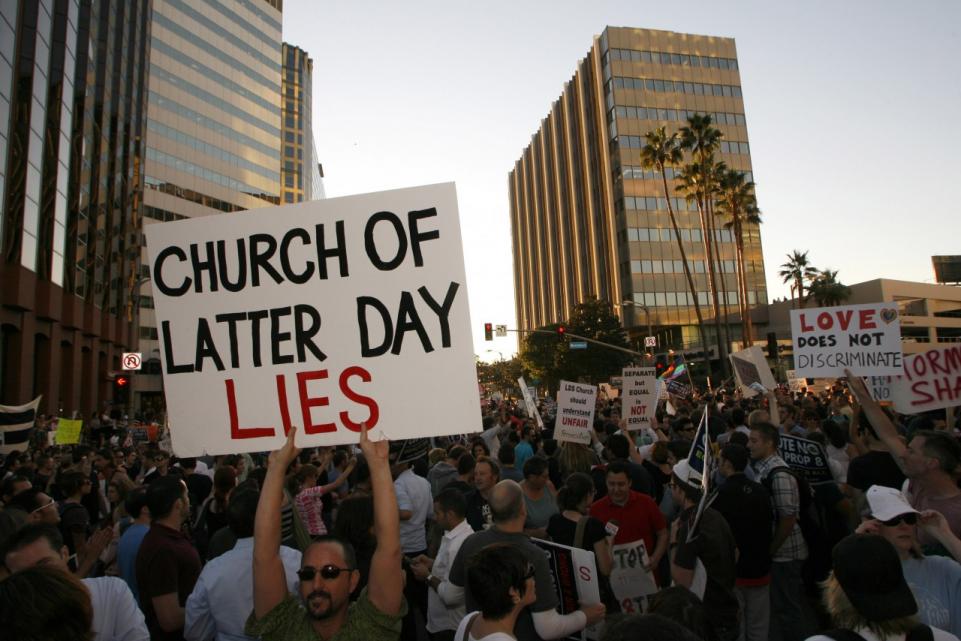
If you talk to many disaffected, ex-, post or former Mormons, or even just Mormons undergoing faith transition or crisis, you won’t have to go very far before encountering the idea that the church is fraudulent. The church is built on lies, and the leaders of the church (both past and present) are lying to church membership. All that is needed to reach this conclusion is to show a mismatch between the narrative the church presents about itself on some particular topic (especially history) and other facts in evidence.
If you disagree with this conclusion, then you either haven’t admitted to the facts, or you won’t follow the evidence where it leads.
Simple, isn’t it?
…Obviously, not everyone feels this way. There are obviously members of the church who are aware of all the historical complexities in Mormonism, who are aware that the narratives within lesson manuals and conference talks and leader pronunciations often lag behind what has been discovered through evaluation of the historical data…and yet these members would not say that the church leaders are “lying” or that the church is “fraudulent”.
Even as a non-believing, non-practicing dude (who nevertheless has gotten many accusations of being an apologist), I can say that I generally don’t think that the church leaders lie. How is that? It gets to what a lie is.
What is a lie?
I don’t want to recite a dictionary definition (this is just one way that I have graduated from Mormonism, see), but I’d like to bear my testimony that there is definitely some room for discussion if one were to check out a few dictionary definitions here.
All I will say is that the sorts of disaffected/post/ex-Mormon narrative I’ve discussed previously often seem to assume that a lie is an untruth. So, someone might tell the truth or they might tell a lie, and the only thing you need to know is whether the statement was factually accurate or not.
My main issue with this reasoning is that it collapses all sorts of distinction. What if, in a stupor of thought, I confuse the Dickensian Artful Dodger “Jack Dawkins” with biologist and atheist Richard Dawkins, and say that Jack wrote The God Delusion? Is that a lie? Am I lying?
I totally concede that is not true. But is there a distinction between a mistake and a lie?
Or, what if, I had read or heard that Jack Dawkins wrote The God Delusion. Now, if I tell you that Jack wrote that book, that is not from confusion. I fully intend (and believe) that it was Jack. Is that a lie? Am I lying?
Still, I concede that is not true. But is there a distinction between misinformation and a lie?
To me, the act of lying implies a certain knowledge or awareness, and it involves an intention. I have to know what is true, know that what I’m stating doesn’t match up with that truth, and be motivated to tell that untruth to persuade you of that untruth.
What does it mean for LDS church leaders to lie?
Based on this evaluation of the differences between lies, mistakes, and misinformation, the claim that the LDS church is based on lies, or that church leaders lie, or that Mormonism is fraudulent, then has an added dimension.
It’s not just saying that there are falsities in the lesson books or in church history manuals, or in the narrative itself.
It’s saying that the church knows the truth, believes the truth, and yet teaches falsity intentionally.
These things are all generally true of claims of fraud as well. Notwithstanding the challenges of applying fraud as a legal concept to religious matters, it’s not just a matter that misinformation caused harm or loss — there still has to be intention. Knowing the minds of victims and perpetrators is integral to the analysis.
Does the LDS Church Lie?
This last question is actually somewhat open. It’s something of a matter of faith — it is a matter of trust.
Even if everyone conceded that there are mismatches between what the church or its leaders teach and what the historical record reveals (which not everyone concedes that, but I think many people can recognize that the church narrative is simplified), there is still a big question on what the church collectively knows and believes, and what the motivations are.
The case in favor of the church…
For example, if someone sincerely believes claims about polygamy to be anti-Mormon lies, and thus continues to promulgate a simplified (but inaccurate) narrative, does that count as lying? They may be aware of certain claims, but they don’t believe those claims are credible. So even if from the outside it looks like they know the truth yet teaches falsity intentionally, really, can we say that they knew or believed?
Or, for another example, what if someone is simply not a historian, and doesn’t have familiarity with the historical record.
Think of all the people who discover the CES Letter late in their lives — a lot of people undergoing faith crisis speak of their bona fides within the church. They weren’t marginal members — they were extremely active, extremely devoted — they just found out competing narratives that they couldn’t square away.
This means that it’s possible for someone to be very active, very engaged in church, and not necessarily be informed on issues until later on. Isn’t it reasonable that the people who move up the ranks of leadership in the church are mostly all in the same condition, with most being unaware of any issues (or not believing the issues to have any merit)?
If these people then are in charge of developing or approving curriculum, are they lying? (Even if they are misinformed and spreading misinformation, are they lying if they didn’t know better?)
What’s Hanlon’s Razor? Never attribute to malice what may be adequately explained by stupidity?
That’s one side of the story, at least.
The reason this is an open question is because, to quote Terryl Givens, there are “grounds for doubt as well as belief, for only in these conditions of equilibrium and balance, equally “enticed by the one or the other,” is my heart truly free to choose belief or cynicism, faith or faithlessness.”
What are the grounds for doubt, cynicism, and faithlessness?
The case against the church…
You likely already know them — especially if you’ve been in any disaffected Mormon community. Even though there are reasonable ways to suppose that leaders did not know or did not know about narratives contrary to what they promulgate, there are also reasonable ways to suppose that leaders did (or should have known)…and this especially becomes more likely as you get closer to the source.
Did Joseph Smith really believe he was engaging with angels? Did he really think he was translating?
If we look at historical claims, the picture is complicated. Firstly, we have to worry about projecting our modern thoughts about historical fidelity and other such concepts onto a past era that may have not have had those standards. (What does it mean to lie if you live in an era in which magical thinking is accepted as just part of the facts of the world?)
But what can we say? What we think of nowadays as translating most likely wasn’t what was happening. Our common visual narratives of the Golden Plates and their use…probably wasn’t what was happening.

It’s reasonable to suppose that many generations of modern church leaders didn’t know the complexities of Book of Mormon translation…or that even if they did, they didn’t believe the alternative narratives. It’s reasonable to suppose that artists are definitely not historians, and that the church departments that decide what art goes where are not engaged with historians. It’s reasonable (at least from the particularly cynical place I come from) to think that the church, for all its claims of correlation, is not uniform in historical understanding, and that the parts that may know more may not necessarily be in communication to the parts that aren’t.
(Although, as more information comes out through credible LDS historians and scholars, it will be interesting to see how that will trickle down through the church. Now that we have official published essays through the church, is there some sort of timer we can set, so that we can say that after x years, if the church hasn’t changed paintings or updated lesson manuals or popularized the LDS topical essays or whatever, then we can conclude that there is intentional deception?)
…but is it as reasonable to think that Joseph Smith didn’t know what was happening to him? Or didn’t know what details were important about what events until months or years later?
(Before you answer that question, perhaps read Stephen’s post on Memories, Simplication and Lies. Human psychology has some wrinkles in it.)
Since brain waves and private thoughts are usually not recorded in historical records, determining mindset and intention is always going to be a difficult process…and in some ways, this process is precisely a choice of faith in the Givensian sense. While evidence may be perceived to stack one way or another in terms of what people did or said, what do we do when all of this evidence only indirectly speaks to what people believed or intented?
In the 2015 Sunstone, one quite popular panel discussion featured four historians making their cases: was Joseph Smith a prophet, sincere visionary, pious fraud, or con man. What was most interesting about this discussion was the extent to which many of the facts in question were agreed upon by all the historians — but one thing that shifted the view from one to another was the intentions ascribed or inferred to Joseph Smith.
If you listen to Christopher C. Smith’s presentation from that panel (he argued con man), you might come away with the idea that the case is almost closed and there is no room for disagreement.
It’s easy to read certain historical narratives or listen to Chris and think that Joseph is a man caught red-handed…and while it’s certainly easy for anyone caught red-handed to say that “it’s not what it looks like,” any observer probably should not be criticized for concluding that things are exactly what they look like…and acting accordingly.
The Choice of Faith
The example of a significant other caught in flagrante delicto in adultery actually offers scripturally rich metaphors for faith as a choice. We often conflate faith with belief, and belief with mental assent to proposition, but if you read enough on religious thinking and blogging, you may be aware that there are other models for faith — for example, faith as trust or faith as loyalty. In this case, one model for faith might be choosing whatever narrative one can that allows one to agree that things really aren’t “what it looks like” when it comes to catching a lover “red-handed” as it were.
However, this seems unsustainable. Fragile even.
But another model of faith — however unpalatable it may be — suggests the choice to be loyal even in sober acceptance of a lover’s infidelity. None other the Old Testament itself speaks of the relationship between God and Israel in these terms. Ezekiel 16 is some super fun reading here. but also read up on the story of Hosea. Just a snippet from Hosea:
3 The Lord said to me, “Go, show your love to your wife again, though she is loved by another man and is an adulteress. Love her as the Lord loves the Israelites, though they turn to other gods and love the sacred raisin cakes.”
2 So I bought her for fifteen shekels of silver and about a homer and a lethek of barley. 3 Then I told her, “You are to live with me many days; you must not be a prostitute or be intimate with any man, and I will behave the same way toward you.”
4 For the Israelites will live many days without king or prince, without sacrifice or sacred stones, without ephod or household gods. 5 Afterward the Israelites will return and seek the Lord their God and David their king. They will come trembling to the Lord and to his blessings in the last days.
To be fair, perhaps this is a misapplication of these metaphors. In these cases, God is perfectly faithful, but Israel — his covenant people — are unfaithful. Can we say we are perfectly faithful and church leaders aren’t, or aren’t we all imperfect in ways?
And at what point is enough enough?
A few questions to consider:
- Do you think that the church is based on lies/fraud?
- If so, what are the clearest examples to you?
- If so, do you agree that it is intentional?
- Do you think it’s reasonable for people to disagree on this? Or is the case certain?
 Wheat & Tares
I believe that Jesus Christ has put forth His hand in these latter days to restore His church, His priesthood, and the fullness of His gospel. I do not believe the Church of Jesus Christ of Latter-day Saints is founded on lies, or that its past or present leaders are liars.
I appreciate your explanation that not all untruths are lies. Even so, I am wholly uncertain that historians are always precisely correct about history. They can and do err in the same ways — maybe some of the alleged facts are actually untrue or even lies. Indeed, a historian might even be wrong when he factually correct. At the last day, even Jesus Christ Himself is going to have a view of the truth that disagrees with facts — when the repentant sinner is judged, and his or her accusers recite all the facts, the Lord might say, “I don’t remember all of that.” But for those accusers, the Lord might remember every detail. With what measure ye judge, ye shall be judged. To a large degree, faith, hope, and charity will matter more than facts. I choose to stand on the side of faith, hope, and charity.
Andrew S, I like this a lot. And I like your nuanced approach. I think, like you, there are distinctions to be made. There are lies of commission and lies of omission and mistakes that, when the church doesn’t admit it made, seem like lies even though they’re not. It’s all quite muddled, at least in my view. But I do think a few things:
1. Taking the most charitable view, I think it’s still obvious that the church and its leaders at various times have at least distorted the truth/conducted correlated cover-ups about church history, Joseph Smith, etc. I mean it just has. Of course, this causes problems for folks who really believe that the church would never lie/obscure things. If one is to remain a member of this church, it’s imperative, IMHO, to realize that all organizations, this church included, will lie, distort, etc. in the name of survival. An organization will always put its own well-being above the well-being of the people in it and that includes this church. That’s just the cost of belonging to an organization. Better to accept that than let it trouble you.
2. The church talks a lot about the idea of and the importance of truth. I think it’s obvious that when it says this, it means either a kind of correlated truth about historical events (the church’s “version” of events) or a kind of eternal spiritual truth (“The Book of Mormon is true”) I think the problem comes in when we start asking what such statements mean. What does it mean to say the Book of Mormon is true? That it contains eternal spiritual principles vital to our salvation? That it’s a “true” and accurate translation of the plates Joseph Smith claimed to find? The problem with proclaiming something true, of course, especially in any kind of historical case, is that there’s always the possibility that that “truth” can be refuted with other versions/facts. And further, it doesn’t mean that those presenting contrary facts are evil or wrong.
3. I think that there are enough examples of the church’s “truthiness” that any reasonable person would be skeptical of its claims. I’m shocked, for example, that the correlation of the different versions of the First Vision into one big meta-version isn’t blowing up the internet. For that, there is no-one for the church to blame but itself. I think a big problem here is that the church is, for an organization that claims to embrace Christ’s teachings, astonishingly resistant to the idea of apologizing or admitting mistakes/errors in a timely manner (See the Oaks’ “The church doesn’t apologize” statement, eg.). I would expect a church with Christ’s name to be first and foremost about honesty, loving kindness and charity. By any measure, I think we fall pretty short of that ideal. Which means we’re just like most of the other churches out there. I actually think that if we backed off a bit from some of our unprovable truth claims, we’d spend less energy/anxiety on policing claims against us and more time shrugging our shoulders about those claims and doing the good work of Christ: feeding the hungry, loving everyone and letting go of all of this correlated truthiness stuff.
In the end, I think that spiritual truth, whatever that might mean to folks, is subjective enough that reasonable people can disagree. In fact, it’s not even about agreeing or disagreeing. It’s about accepting or not accepting someone else’s spiritual truth. The subjective validity of religious experience simply can’t be argued against, really. If I claim I had a vision, no one else can tell me I didn’t without making themselves look ridiculous. That’s, of course, what the church depends on for most of its claims to truth. Whether that’s a good or bad thing is, I suppose, up to each of us to decide.
Andrew. I do really like the distinction you highlight between lies and non-truths.
Up until a few years ago I think that most non-truths/telling only one side of the story was done by passing on from others. I think even up into the ranks of the church I can give many of them a pass. But I also feel that there were a few of these non-truths/less than the whole stories that were setup by someone knowing generally the whole picture and not wanting parts to be seen/known. I can’t give them as much of a pass.
So where does that leave us now? I fully agree there is a clock ticking and the longer we have essays tucked away and not talked about (kept for future plausible deniability that “we never told you”) the more I fear the church is still carrying on with that same behavior.
I was about to re-write much of what Bro Sky said, but I will just say I agree with him.
The only other thing I would add is that the church is still pushing, “The BOM/1st vision/etc are either 100% true or they are 100% false.” For many that get this ingrained, they see some of the underbelly and they feel they are morally obligated to throw it all away since it obviously isn’t 100% true. The church needs to be more welcoming and a bit less, “Either you are with us or you are an enemy.”
I do not ascribe bad motives to church leadership. I believe any lying or misleading or omitting done on their part stems from how they view their role.
Elder Oaks used the analogy of a litigator in court presenting the facts of his case in the way most favorable to his client, with no responsibility to be fair and balanced. Like a litigator trying to convince a jury to reach a verdict (guilty or not guilty), church leaders are trying to help the membership to gain a testimony (the church is true). So they present information that is faith affirming (massacre at Haun’s Mill) while omitting information that is faith challenging (Mountain Meadows Massacre). Where conflicting accounts exist of an event, they are likely to choose the most faithful, orthodox version (First Vision). If negative information is to be raised at all, it is only to prevent critics of the church from making uncontested assertions that would damage testimonies by presenting a faithful interpretation of the information. They will be generous with questionable accounts, rumors, and apologetic arguments that support the faithful history, while scrutinizing and holding to the highest standards of evidence any challenges or criticisms. They will present the faithful interpretation of evidence as the correct one no matter how improbable, so long as it is possible. To do otherwise would be an abdication of their sacred duty, as they view it, to bring people to Christ.
Church leaders do not view their job like that of a journalist, or a history professor. They are not giving a balanced overview or presenting both sides. They are trying to get people to reach a specific conclusion, which they happen to believe is capital T Truth.
I think church leaders are generally acting ethically and morally within the parameters they have established for themselves (with a few exceptions like Paul H. Dunn, etc.). And so I would not call them liars and frauds. However, I happen to disagree with their approach. I think it is immoral to ask for significant, life-changing sacrifices from people while withholding highly relevant information from them just because you believe you are justified in doing so. I think it is unjustified to treat your own role like that of a litigator in an adversarial system where the rules are not well defined, you do not make it explicit what you are doing, there is no judge to keep you honest and fair, and you are actively warning people against hearing the evidence from the opposing side. This is especially the case for children who are born into the church.
Finally, I think the advocacy role that church leaders take on actually retards an honest search for the truth. You are less likely to ask hard questions, to re-evaluate your position, to walk away from false claims, when you are an advocate. We should be seekers, we should cultivate the questioning spirit. We should re-open and re-examine our assumptions. Doing so might lead to fewer members, or less fervent ones, but I think it makes for a healthier, truer organization.
Joel – If I were a betting man I would say you were in the legal field! 🙂
I think your analogy holds SOME water, but when leadership has continually in my lifetime told me not to look at non-church published materials, it moves from a lawyer in a court like scenario to more like the Wizard of Oz and being told ignore the man behind the curtain (with strong moral repercussions for disobeying). I feel they are being forced to make most of the “concessions” they are now. It does seem that people were excommunicated only a few years ago for what now is included in the church published essays. Then we hear “the truth is never changing.” There must be a LOT of stuff in the church’s teaching that isn’t truth as a ton has changed.
I liked the reference to the CES letter. It makes a big push with a word print study that is fundamentally flawed (eg http://www.jefflindsay.com/bomsource.shtml for a humorous analysis). Yet I’ve yet to meet a fan of the CES letter who when exposed to accurate analysis on that issue suddenly drop the letter. They are generally more than willing to embrace it.
As to the various versions of the first vision, I encountered them many, many years ago and the analysis I had made them faith supporting. I have to bite my tongue to not see the contrary approaches as willfully in bad faith. It should be noted that for years the big criticism from the anti Mormon crowd was that the first handwritten version showed a different date –which it clearly does not. The latest attack is more of the same in my perspective.
My post http://www.wheatandtares.org/20861/memory-simplification-and-lies/ was really about that.
Anyway, are people who fall for that criticism willful co-parties to intentional fraud aimed at attacking the faith of others and sunning against the Holy Ghost?
Or are they over simplifying in a way born of ignorance and reliance on others?
If I apply the same rules to them as they apply to the church, they are sons of perdition.
If I’m rational and reasonable, they are just human like I am.
The bottom line is that it is good to remember that for the most part we are all human.
At least I hope we are all human.
Replace lie with deceive and clarity emerges. Whatever your definition or spin of lie, it is clear that the church deceives. For example how many wives did Joseph have one or many?
More than one. That is in the D&C.
As is the end of polygamy.
It is also clear that the church is not a monolith.
Too often it seems that we treat it that way.
Kind of like those who attack the four gospels in the New Testament for not being in lock step.
The church was not a monolith then either as the fights between Peter and Paul reflect.
So where are the others? Joseph and Emma
Not in that statue which was part of Dallin Oaks effort to get people to see good in Emma.
I would submit that in an effort to focus on Emma should be focused on Emma.
Is this image correct?
The church tends to leave the truth in dusty filing cabinets or verses not often visited while creating public relations impressions to the contrary. Isn’t this deceptive?
Where has this thing been most of my life?
Please fish my last comment out of the spam filter.
re 1:
ji,
I definitely can appreciate that historical knowledge is not set in stone. It’s not always 100% precise. But I actually want to use one thing that you say to highlight the point I’m trying to make in this post.
You say:
When you say “some of the alleged facts are…even lies,” are you suggesting that some historically deliberately and intentionally tell untruths? Because my point here is that that’s the *only* way that it would be a lie. If historians are incorrect because they were misinformed or because they were missing a critical piece of data or a critical perspective, that’s not a lie. Talking about lies immediately questions motivation.
re 2:
Brother Sky,
I like your first point, but I wonder if it doesn’t cut against your third point a bit? If the church is doing something that we should expect from an institution, then shouldn’t that be built into as “normal” organizational behavior? and if it is normal organizational behavior, why would we be particularly suspicious of the church’s claims where we wouldn’t necessarily be as suspicious of other organizations’ claims?
Even if we “expect a church with Christ’s name to be first and foremost about honesty, loving kindness and charity,” why would we not also expect our church (or any church) to nevertheless still have human institutional hiccups that institutions and organizations all have?
In this way, I’m reminded of a lot of nuanced commentary I’ve read on sustaining leaders. It’s not healthy to think of leaders as infallible, but even more, we shouldn’t think of leaders as necessarily having any additional personal merit than any other member… so looking at what it means to sustain leaders shouldn’t start with the unrealistic ideal of infallibility, or even the idea that they are more “capable” than we are. This doesn’t mean that leaders are useless — just that their use is not dependent on notions of merit/worth/accomplishment/perfection.
I TOTALLY agree with your last paragraph. I think that’s probably ultimately what the Givensian “choice of faith” stuff comes down to. No matter what we know about history, there’s a lot of subjective interpretation that history cannot directly report.
Andrew, I think some things put forth as facts by historians may not be true — some educated opinion, some non-malicious error, and yes, some outright lies. In a discussion of truth and a presumed battle between the Church and historians, I wouldn’t want anyone to erringly assume a starting point that everything put forth by the historians is true. I want to be charitable to the Church and to historians, with hope that the historians will be charitable, too.
Howard –you mean the seer stone that was in the Ensign and the Friend magazine?
Good of you to point to that.
As for art, like Michelangelo’s David (it has him uncircumcised) … This is well worth reading.
Click to access From-Darkness-unto-Light.-Appendix.pdf
Stephen,
I’m guessing that you are familiar with a concept called preponderance of evidence?
I’m thinking of Brodie and her story about Joseph Smith pretending to walk on water. First edition footnotes that as without a source –just a story she repurposed. Later she kept the story and dropped the footnote. I used to ask people who vouched for the solidity of her citations and stories to find me the source. Of course they could not –but chose her story anyway.
http://adrr.com/living/broadie.htm For more.
But that is a good example of how some historians curate their work.
Howard, I’m aware that over the past fifteen years in impartial courts I have averaged over twenty motions for summary judgment granted a year (including voluntary dismissals rather than continuing on).
So I’ve a good idea of where an unbiased forum will go with facts.
So one or a few references are made to “A” in the past. This is followed my many that strongly imply “not A”. This is not deceptive?
re 3
Happy Hubby:
I would definitely say that to the extent there is a mix, then that’s definitely a problem. And I can see how people could believe that some leaders know more but don’t want to disclose, vs other leaders know less and think they are already disclosing everything that’s true, etc.,
I think that the church sets itself up for its own problems by creating black and white dichotomies like “it’s all true or a fraud”, when there are DEFINITELY other options.
re 4
Joel,
What would you say to those who think that being a litigator is an inherently “dishonest” profession because they are, as you say, trying to make the most favorable case for their clients? Do you think there is a distinction to having a system of rules in an adversarial system that makes church leaders “different” than litigators?
In some sense it doesn’t matter if the church lied or only said untrue things with honest intentions. While I agree there is a moral distinction, either way they are in error. In a church that places so much emphasis on authority and following the brethren, no room is made for the possibility that what leaders say in official capacity is untrue, whether that untruth is a lie or a mistaken belief. And herein lies the problem– If the church cannot acknowledge that it has officially taught untruths, while the historical record clearly shows that it has (e.g. justification of Priesthood ban, Adam-God, BOA), then the Church loses all credibility. It is not enough to simply say individuals advanced theories that were later shown to be incorrect. The institution itself must acknowledge that it has officially taught untruths, and with that acknowledgement recognize that such a situation could happen again. I can embrace an imperfect Church, it is a hypocritical Church that I cannot tolerate.
re 6
Stephen,
One of the interesting (and a bit frustrating) things is that many disaffected members will just point to church leader statements and point out that they are judging the church by its own standards. (E.g., things like, well, Gordon B. Hinckley said that the BoM is either true or a fraud…sooooooo)
So your comment here:
reminded me of that. It’s difficult to have a peaceful reconciliation, you know?
(also, on the internet, no one can tell you’re not a human)
re 8,
Howard,
I think deceive has the same problems as lie. Deceive to me is synonymous with lie. I would say from my vantage point that it’s clear that the church has misinformed, but judgment calls on motivation are not as set in stone. Ultimately, we may conclude that on some issue the church deceived/lied, but that’s always an indirect assessment of what they know and believed and intended, and not just an evaluation of what aligns with the facts. so, asking, ‘How many wives did Joseph Smith have?” is not the sort of question that can differentiate deception from just being misinformed.
It calls for judgement Andrew. Is it your judgement that the church hasn’t deceived?
Well said Andrew.
The idea I’ve thought a lot of lately is that of informed consent. This brings to mind BKP’s direction to CES instructors that everything that is truthful may not be useful. In essence, don’t paint the most comprehensive picture possible. This direction indicates to me a mindset something like “We have the truth so our ends justify the means.”
In my opinion this taints our agency/choice. And, as some have mentioned above, to ask so much of membership while actively suppressing or directing membership away from information that might more fully inform their decision is deceitful and dishonest. This is even more egregious coming from an organization claiming to be the source of the most truth. So much for letting the truth stand on its own two legs.
Oh, they feel justified and believe what they are doing is right, but their judgement has been corrupted by power. They prefer the idea that they can’t lead anyone astray to the dangers of authority as described in D&C 121.
The truth of the latter much more easily demonstrated than the former. Case in point. Blacks and the Priesthood essay. To say this practice was based on policy and not doctrine seems ludicrous given the quotes and canonized scripture showing it was both….
Btw, deceive is not synonymous with lie. Deceptive use of the truth can be used to deceive.
Andrew S asked “What would you say to those who think that being a litigator is an inherently “dishonest” profession because they are, as you say, trying to make the most favorable case for their clients? Do you think there is a distinction to having a system of rules in an adversarial system that makes church leaders “different” than litigators?”
I would say that the honor of the litigator profession depends on having a fair adversarial system where both sides are represented by competent counsel, and a non-biased judge enforces the rules, and the decision maker hears both sides. My objection to the LDS leader as litigator is that they want to present the most favorable case for the church, but then dissuade people from hearing the other side, and there is no “judge” figure to enforce the rules and protect the interests of the jury. For instance, LDS leaders have excommunicated members for publishing true but embarrassing information about the church, which then attaches the excommunication label to the person, discredits them as a source for information, and poisons anything they produce. Certainly there is a fear that the critics are not playing fair, that members who hear both sides will lose their testimonies, and so they have to play hard ball and take every advantage they can get. I guess that’s the logical approach when you believe that opposing counsel is literally Satan. Given what they believe the stakes are, it’s pretty amazing that LDS leadership is as self-constrained as they are.
Vinz. The ban started as policy. People tried to justify it as doctrine. When Bruce R McConkie was asked to research it he concluded that to the contrary of his earlier published conclusions it had no doctrinal basis. He then supported the policy change.
So. Would it be fair for me to call your assertions ludicrous or would it be better to say you appear to be arguing from what I would think of as flawed assumptions?
I think the use of charged language leads to a great deal of crankiness
As an aside.
I’ve spent more than forty years with some chiding me for being too terse and then having people complain I am including too many details and just need to get to the point. Finding a balance can be hard.
When I hear people complain about the things they were not told I tend to flash back to years of people not being interested when I tried to tell them.
As for oversimplification– when combined wirh emotionally charged language…
I’m not too concerned about whether there was intentional fraud. I’m willing to give faith-based organizations plenty of space to craft their own narratives. My view is that regardless of intentions, the LDS faith has lost control of its narrative.
The LDS faith has spent the last 150 years tightly controlling its own narrative. Excommunications. Correlation. Historical sites. Claims about the origins of entire groups of people. Really, its all about this question: Who gets to write the LDS narrative?
Answer: Not the LDS leadership. Not in 2016. That ship sailed.
I was once LDS. I have family and friends who are LDS. I have children who may choose to be LDS as adults. If you want to be LDS, if that is going to be your path in this short life, my counsel would be to start crafting your own meaning out LDS narratives irrespective of the narratives the organization teaches. The organization’s path and approach to meaningful religious experience is unsustainable.
The faith’s narrative for itself is tied its historical claims, and that history is relatively fresh. Practicing faith should not require deep historical understanding. There should be no such thing as a “church historian.” That’s a misnomer. Churches don’t have historians and historians don’t work for churches. They’re in separate businesses.
Craft your own meaning and purpose out of the LDS faith’s narratives if that’s the path you choose because the LDS faith is no longer steering its own ship. Just take a deep breath and accept that it’s all going to be much messier from now on and start developing your own meaning.
I guess another way to say this is that becoming a “Mormon apologist” is a poor life choice. Becoming a Mormon antagonist is a poor choice. Find your own meaning, don’t expect someone else to write it for you, and move forward with your life.
Josh– you are right. We need to avoid crankiness and make progress.
Stephen,
I’m probably not part of the “we” in the sense that you’re using it.
Well, you sound like you are trying to avoid being cranky and make progress.
I think that is a good goal in or out of the Church.
🙂
re 28 and 31
Howard,
I can see many cases where people point out specific things the church has said and I can see how they would say it’s deceptive. I tend to attribute to misinformation rather than intention.
I guess my point in comparing deception and lying is that intention is critical in both. Do you dispute that?
re 34,
Josh,
I definitely think that the church doesn’t get to have the final say on narrative, and it’s struggling to live with that reality.
Stephen,
“We”: Those of us who refuse to be cranky about faith because life is too damn short. And, we love friends and family who believe differently than ourselves because … life is too damn short.
… I’m in. I’ll be part of that “we.”
I agree Andrew, intention is critical to both.
But true mistakes tend toward randomness don’t they and intention tends to point more in some general direction. In the church’s case mistakes seem to magically obscure embarrassing issues, that is “mistakes” tend to suggest direction or coverup rather than the randomness of just simple mistakes.
All this is then defended by apologetics which in itself is a fancy deception often offered by those with fancy credentials furthering the deception that these smart guys must know what they are talking about.
But apologetics is not a search for the truth instead it is a biased defense that selects or bends “evidence” to fit a desired conclusion.
All of this taken in total is simply sophistry aimed at more deception. It is deception that invites the membership to go back to sleep rather than seek the truth or be awakened.
re 40
Howard,
I wouldn’t expect true mistakes to tend toward randomness. To use a concrete example, if I were working with someone who didn’t understand accounting on accounting homework, I wouldn’t expect their mistakes to be random. Rather, I would expect that, depending on their (mistaken) conceptual framework, they would make consistent mistakes according to their particular kind of misunderstanding.
This is usually why seeing people’s work is so helpful — because you can tell that they have troubles with one thing but not some other thing, and you can tailor your approach accordingly.
I think that church leaders believe the church is good and correct. So, even if they discover information to the contrary, they are likely to discount that. (And I don’t think that’s dishonest — that’s them deeming the information not to be credible.) And I think that a lot of what the church does is consistent with that.
IOW, if we look at the church telling people not to look on the internet, there are multiple ways to interpret why they might say that. One reason might be because they genuinely believe that the internet has incorrect information on it. Another reason might be because they know and believe that the internet has correct information, but they don’t want members to discover that.
The latter is deception, but the former isn’t. But both motivations will lead to similar actions, statements, etc.,
Josh, no. 34. Spot on comment. Narrative control has been a key to this church and its leadership for so long that, in my opinion, folks in SLC are panicking because of the loss of narrative control. The denigration of the internet (except, presumably, pro-Mormon sites) is so universal as to be comically absurd. I grant the internet isn’t the place to go if one is searching for unbiased truth but, as evidenced by the recent press releases and the newsroom’s incompetence, neither is the LDS church.
Andrew S. (no. 18) You make a fair point and ask a fair question. I can see in my comments what made you wonder if I was undercutting my own points. Far enough, but I suppose for me, the difference is what’s at stake. Indeed, I do think we simply have to accept the fact that the church is less than honest with us, often about important matters. I suppose accepting that fact would push one either to stay and change things or to simply leave and find somewhere else for spiritual nourishment. I suppose what makes me feel that this is a particularly egregious case, what made me write what I did in my 3rd point, is that the church isn’t just a business, it’s (supposed to be) an organization that’s chiefly about the welfare (spiritual AND temporal) of mankind. According to its own rhetoric, it ought to be held to a higher standard of truth than, say, Microsoft or Amazon. I don’t necessarily think it’s a contradiction to say on the one hand that that we should expect the church to be dishonest and on the other hand to exhort it to do better. Thanks for a quite stimulating post.
Andrew, that is my experience as well.
I deal with people who are involved with law they don’t understand and going way off base.
But it would be wrong to say they are trying to deceive anyone. At least often. But they tend to be very consistent rather than random.
re: Howard’s quote: “It is deception that invites the membership to go back to sleep rather than seek the truth or be awakened.” So well put. I may tattoo that on my forehead this weekend.
If you bet the tattoo, please send us a link to a picture of the tattoo. That is going to be a first for our blog!
🙂
I am grateful that the Church has led me to experiencing a close relationship with my Lord and Savior Jesus Christ and continue to remain active in the Church. With that said, I think members deserve an apology for misstatements that have been made by Church leaders.
1. If they require absolute morality of their members, they should expect morality of its leaders and apologize when this has not happened, ie. Joseph Smith marrying women who were already married.
2. If they require honesty of their members, they should be honest about mistakes that have been made in the past by Church leaders and apologize for them, ie. blacks being denied temple ordinances and priesthood, Brigham Young’s Adam/God teachings, etc.
3. If they expect members to show compassion to church leaders when they make serious mistakes, they should show compassion to church members who make mistakes as well. Too many members are being excommunicated who are faithful, valiant saints. Lavina Fielding Anderson is an example of this.
Stephen R: I’ll keep you posted! I always wanted a tattoo of Brigham Young’s saying: “Prayer is good, but potatoes are better.” Surely no LDS leader could object to a permanent application of the words of a prophet? 🙂
And ye shall know the truth, and the truth shall make you free.
John 8:32
The church has clearly practiced deception in the past, but I think Joel excellently pointed out that church leaders are in a position of putting the church (institution) in the best light possible so as to not distract from the value of the gospel. Although some leaders may have been ignorant, I’m much more convinced that leaders have withheld some facts because they were not useful towards building testimonies. Elder Ballard was pretty clear that the inoculation method has become necessary only because the church cannot control the historical narrative members hear anymore.
Bro Sky – I am afraid to ask, but where were you planning on getting the “Prayer is good, but potatoes are better” quote? Enquiring minds want to know. 🙂
I really enjoy when these blogs have a respectful dialog. I feel I do learn and it gives me real food for thought (orders of magnitude more than SS / PH meetings where my main thought is “how much longer till this is over?”)
But I am struck a bit among all this somewhat theoretical philosophic discussion with the thought, “Would God make this all so hard for us to figure out?” Out of the 3 guys here making most of the discussion (of which I know I am super junior intellectually), you guys are smart. I know of tons of people I have known in the church that are VERY good people. They go to church, they are honest, they don’t drink, they are good husbands and fathers, they help other people – but if you put them in a room with you guys when your having this discussion, they are going wonder what in the world you guys are talking about. I am just having lots of trouble reading apologetic material and thinking about how your average Joe is supposed to figure this all out. I hope I am not interrupting your conversation here. Feel free to ignore me. 🙂
But would the Newsroom lie?
re 42,
Brother Sky,
we agree probably on faaaaar more than what these comments imply, but I usually try to find some place of disagreement just so I’m not commenting with “gr8 comment!!!!”, and this comment will probably fit that as well 😉
So, I would probably say that accepting the fact doesn’t just mean “stay and change things” or “simply leave and find somewhere else”. It could mean, “stay, but accept that your spiritual and temporal welfare is ultimately your own responsibility.”
I want to underscore that point. When we accept that our own spiritual temporal welfare is our own responsibility, we might decide that it’s better for us to work on that independently. Maybe it’s right for our particular situation to leave the church and maybe find somewhere else.
But I don’t think it’s impossible for some people to conclude that they still get a lot of value from the church.
When I think about the difference between the church as a church and businesses like Microsoft and Amazon, then, I can realize that there can be some areas of similarities and some areas of differences. I think in terms of similarities I’d want to say that all of them are limited by human organizational weaknesses. I would not want to put the church to a “higher standard of truth” than is possible for human organizations.
But what I’d want to say is that I expect Microsoft and Amazon to offer different *products* than the church. And is this true? Yes, it is.
I can still ultimately decide that I don’t like the product the church is offering. (And I personally don’t. The church’s product isn’t that appealing for gay dudes, lol.) But I can recognize, whether Amazon or Microsoft or this church or any other church, that I have to evaluate that product with my own judgment. Of course, Microsoft thinks I should use everything Microsoft, and Amazon thinks I should get everything from Amazon, and the church thinks I should live my life exactly as they prescribe. But just because I can critique their marketing (while being aware that it’s only natural that they will market the way they do), that doesn’t mean I have to totally boycott any of them. Maybe I end up doing so, but it doesn’t just follow from disagreeing with them.
and then
If I’m being independent about my spiritual and temporal wellbeing, I can be more discerning about whether I find the church’s all-or-nothing rhetoric helpful. I don’t, and I think the church creates a lot of the problem it faces because of it, so I sympathize with folks who take the church at its word and then say that it doesn’t live up to that. But that’s not the only way to see the church, whether inside or outside of it.
A Happy Hubby: Well, I’ve already got the starship Enterprise tattooed on my back, so I’d have to find some other place. 🙂 The forehead seems quite natural, actually, since mine is rather large (went bald at 28).
I disagree that “the church has clearly practiced deception in the past.”
If someone asks honest and peaceable Grandma to tell the story of her family, who would accuse Grandma of deception if she omits some details and puts a kind spin on other details? The crowd here might, but that would be uncharitable. Grandma tells her story for her worthwhile and noble purposes, between her and her children and grandchildren, and it is how she chooses to see truth. She is not a liar or deceiver.
And re Happy Hubby’s comment about would God make this so hard?
I don’t think he would. I think it’s the worldly part of the organization that Andrew S is referencing that makes it hard. In a nutshell, the biggest challenge to my own faith journey has been the church itself. I think it’s the church (as well as a number of apologists) who make things hard. The gospel of Christ is really pretty simple and I try to cleave to that and just have a bit of intellectual fun with some of these other questions. There’s a church down the road from me that calls itself the PBJ (People Being Jesus) Church. They hand out PB and J sandwiches every Sunday to anyone who stops by who is hungry. I think they’ve about got it right: Act in the world the way you think Jesus would. The rest of this stuff is pretty academic except when, IMHO, the church itself makes a big deal out of it.
And I do think charity is huge. You’re right, I suppose, that a fair amount of people might wonder what the heck we’re talking about. Of course, I wonder the same thing when I go to Sunday school and hear a lot of correlated, uninterrogated lessons. It doesn’t mean I think the people giving the lessons aren’t good people and it certainly doesn’t mean that I feel superior to them in any way, shape or form. But it does mean that we need to try to love one another despite (or maybe because of) the fact that we don’t know what the other is talking about. If we have love and kindness in common, that’s a great place to start.
Andrew,
When we accept that our own spiritual temporal welfare is our own responsibility, we might decide that it’s better for us to work on that independently.
Well said.
To continue with my Grandma example, I might get a different take on certain matters from Uncle Joe or Aunt Bess. I can hear what everyone has to say, appreciate their perspective, and make my own decision about what I tell my children. No good comes from calling honest and peaceable Grandma a liar because she doesn’t have the same perspective or recollection as Aunt Bess.
re 50,
AHH,
I am reminded of something that Adam Miller used to say a lot on his posts (and Adam is definitely someone who’s waaaaay above my level): he would point out that theology is gratuitous. It’s not essential. It’s a rube goldberg machine — it takes way too much effort to do something silly or simple.
I think of blogging kinda like this. Ultimately, what’s more important is living a good, honest life, right? If that is seems clear-cut, then no problem!
W/r/t the question: “Would God make it that difficult?” I think of advanced physics. Physicists these days come up with hypotheses and theories that sometimes make me think that they are just making a huge joke at all of our expenses. It turns out that if you want to go there, the universe can get really complicated.
Yet, from our day-to-day life, we probably don’t need to know much about quarks.
Andrew, I think I’m with you on your latest comment on my comment. I believe that ultimately, it IS our responsibility to look after ourselves spiritually and temporally. Of course, to me, that means putting more faith my conscience and moral instincts than in anything the church leaders say or would have me do. That sounds eminently logical to me, but I think a lot of so-called mainstream members might have a problem with what I just wrote. It makes no difference to me whether they do or not, I’m just trying to point out that sometimes the very cultural fabric and identity of this church encourage us to work against being spiritually self-sufficient.
Happy Hubby–I think the simple message of charity and loving kindness is the core. That isn’t complicated (though like many simple things it can be hard).
We make it hard by our overlays.
And by treating the simple message as a lie when it doesn’t include all the context, sub context and details.
I often compare it to living in a house (living and acting with kindness towards others) and building a house (knowing how bricks are made or electricity works).
I think God doesn’t make it hard. We make it hard. Which is ok. We generally have lots of excess time and energy to spend.
Andrew,
People tend to repeat some of their their mistakes and other mistakes are more or less random but a room full of accountants (or correlators?) will tend to make different mistakes than one another producing something approaching randomness unless the group has some kind of bias (like make the church look good). That bias to the extent that it is conscious (and part of it is!) is deception not to mention it is lying to oneself which is what many LDS Mormons do so well.
If we apply Ockham’s razor to the question of church deception we quickly see that far fewer words and mental gymnastics are required to creditably admit the deception than to creditably refute it.
re 58,
Brother Sky,
I do think that Mormonism has a community focus and a focus on hierarchy. So, in a Mormon context, the challenge is to reconcile or wrestle differences between individual conscience, community norms, and leader pronunciations. I don’t think this necessarily works against being spiritually self-sufficient — because an individual’s choice to take community into consideration, to take hierarchy and authority into consideration — those are still individual choices.
re 60
Howard,
I don’t think most bias is conscious, so I don’t think most bias is deceptive. Yet I do think most people have biases. I would assume a roomful of accountants would have similar biases as a result of training, experience, personality types, etc.,
Ockham’s Razor is great if you want to simplify stuff, but it’s usually glosses over some really important stuff. Is wanting a super simple answer over more complexity a conscious bias or an unconscious one?
Andrew,
Much of organizational bias is conscious, should you land a job at the COB I suspect you would notice it very quickly.
I have been blessed with what I consider to be personal spiritual experiences. When I have tried to write them down, it is, indeed, very difficult to find language that can adequately convey the way your senses were aroused by the experience. It is difficult to verbally articulate the nature of the personal impact. For that reason, I really don’t share them much, and I am sure others are the same. Even if I feel I have provided an accurate description of the event in writing at one time, they way I interpret the experiences changes with time. When I reach new milestones, say goodbye to loved ones, and participate in different church callings, the nuances that I once felt were the most correct can evolve.
Those experience lead me to sympathize with Joseph’s mission and his duty to proclaim his spiritual experiences without having our modern luxuries of large libraries, word processors, and now internet-based encyclopedic databases. He continued to receive line upon line, but was receiving revelation for which the previous “lines” were clarified.
We live in a world that surrounds us with lies and fraud, so it is not likely that something pure can be propagated according to the mission without becoming spotted somehow. If you have never been tempted to lie to protect someone you love, then you must have had no one to love. I wonder about the validity of Joseph’s plural wive’s testimonies that they were sexually intimate with the prophet. They were, after all, motivated to protect the truth claims of the Brighamite restoration branch and it’s hallowing of polygamy, so of course they would want to say “YES WE WERE” sexually intimate. Eliza Snow’s answers are amusingly cryptic in that she did not answer YES, but IMPLIED something for which YES was the takeaway. Maybe YES was the correct takeaway, but she had a gift with words.
There’s also the untruths that come from not having an appropriate venue to discuss an issue in full detail. When Larry King said “No Caffeine?” and Gordon B. Hinckley said “Right”, it was a good one word summation but was not the sum total of truth. In many ways this can be tied to some portion of an answer going back to ‘we don’t know’. Those who seek answers from church leaders and feel that the church leaders are not responding may often time be dealing with the two issues venue/lack of full light and knowledge. Agitators see a role of giving the prophet an issue–like Emma did with the tobacco spit and the prophet will return with a revelation. Sometimes that is not God’s way.
I had the opportunity to hear Gordon B. Hinckley speak at my college institute while he as a counselor in the FP and a member of the audience asked him when there would be a temple in the city we were in. He smiled and had a twinkle in his eye and gave the best answer: if the members of the church are ready and it is the will of the Lord then it will happen. 26 years later a temple was announced, btw.
Ji, the church practiced deception often surrounding polygamy. This is fully admitted in the gospel topics essays (and I am happy that it is). Early polygamy was denied publicly in “carefully worded statements.” There have been personal family stories where I have to deal with discrepancies between historical versus family records, and I’ve been told by church-employed historian’s to assume the public records were deceptive. My pioneer ancestors were happy to share stories about deceiving mobs, government agents, or whatever in order to protect family members and church leaders. The gospel topics essays are clear that while the 1890 manifesto said the church would publicly refrain from teaching polygamy, the church did not interfere with members who chose to practice it for religious reasons. It was this understanding that Joseph F. Smith stated under oath that then prompted the 1904 manifesto explaining that members would then be excommunicated for entering into new plural marriages. When the church today states that polygamy ended in 1890, the truth is a bit more messy than that. The church has been upfront that deception was practiced by both members and church leaders. The question is whether the deception was justified, and I believe most church leaders would argue yes.
Mary Ann,
Thanks for the clarification. I thought you were talking about more recent times. Yes, I suppose there was some deception towards the hostile national government back in the polygamy days. I’m glad those days are behind us.
I’m not sure the deception you describe back in history was malicious or sinful, though. It may have been self-preservation. The Lord told Abraham to hide his real relationship with his wife when he went into Egypt. I can easily imagine (and justify) a German answering “no” when asked by the Gestapo if any Jews were in the cellar.
Boy oh boy, Mormons performing complex mental gymnastics in order to find their version of “truth” just gives me a monumental headache! I thought our God was a God of order, clarity and simplicity: certainly not this God who support such word twisting and obafucation. The LDS Church is losing all credibility.
lefthandloafer55 — that was pretty content free for a comment. Generally we prefer comments to include some comment beyond pejoratives.
re 9 @Stephen R Marsh,
You wrote: “That is in the D&C. As is the end of polygamy.”
Fun fact, though: the end of polygamy as represented in OD 1 was a lie. Full stop.
From the recent lds.org essay “The Manifesto and the End of Plural Marriage:
“The ledger of ‘marriages and sealings performed outside the temple,’ which is not comprehensive, lists 315 marriages performed between October 17, 1890, and September 8, 1903. Of the 315 marriages recorded in the ledger, research indicates that 25 (7.9%) were plural marriages and 290 were monogamous marriages (92.1%). Almost all the monogamous marriages recorded were performed in Arizona or Mexico. Of the 25 plural marriages, 18 took place in Mexico, 3 in Arizona, 2 in Utah, and 1 each in Colorado and on a boat on the Pacific Ocean.”
This was not the act of fringe members or rebels outside of leadership. John W Taylor and Matthias F. Cowley, both then-members of the Quorum of the 12, entered into new polygamous marriages during that time. Furthermore, though the private minutes of the Q12 and first presidency, as well as recorded and published statements by general authorities made it clear that the polygamy ban was intended to be quietly continued in Mexico and on the high seas, Woodruff stated under oath that the manifesto was intended to apply to “every nation and every country”. Damnable lies all over the place (You can read all about that in “LDS Authority and New Plural Marriages, 1890-1904” in Dialogue, Volume 18, Number 1, Spring 1985).
And there are also many other lies and deceptions which the leaders told and practiced, the which, if they should be written every one, I suppose that even the world itself could not contain the books that should be written. Amen. (with apologies to John 21:25)
/sigh.
We know that Matthias F. Cowley was removed from the Quorum of the Twelve over his actions and then had his priesthood suspended while whether or not to also excommunicate him was being debated.
tokenlinguist — what am I to make of your leaving those facts out? Should I go “you clearly intended to deceive. full stop.”?? or should I conclude you did not have all the facts and that going into them might help you understand the reality of what was going on?
As for John Whitaker Taylor (May 15, 1858 – October 10, 1916), he was a member of the Quorum of the Twelve Apostles of The Church of Jesus Christ of Latter-day Saints (LDS Church) and was the son of John Taylor, the third president of the church. While he was an apostle, Taylor was excommunicated from the LDS Church for opposing the church’s abandonment of plural marriage.
https://en.wikipedia.org/wiki/John_W._Taylor_(Mormon)
I think it is important not to just draw bright lines, assume people are intentionally trying to deceive (if tokenlinguist was really trying to deceive anyone he or she wouldn’t use points that a simple search of Wikipedia would reflect were not terribly accurate — no one would do that if they knew the actual facts and how easily obtained they are), or are other than emotionally invested in conclusions that may not be correct.
But those conclusions are not rooted in an intent to deceive.
Which is the hard part of dealing with these discussions that have so much emotion.
They resigned from the quorum in 1905, after the “whoopsie” manifesto #2, because they would have made the Smoot hearings an even greater embarrassment (which is impressive, since that’s where the prophet admitted that he and the other authorities aren’t, like, real prophets or anything). I can’t prove whether their violation of manifesto #1 was known before then or not, but it seems awfully convenient that they only get the boot once even more pressure is applied to the church re: actually stopping polygamy for real this time.
Anyway, do you have anything on the other boldfaced lie I mentioned, where the intent to continue the practice outside the US is documented, but Woodruff said otherwise under oath?
Andrew,
I think part of the problem is that some people conflate the Church and its leaders or members. But really, members don’t deal with “the Church” — rather, we deal with other members. When a bishop makes a decision, it is that man who is making the decision. When a general authority speaks in general conference, it is that man sharing some thoughts. When a ward Primary president picks a song for sharing time, it is her selection. When we look at all of the acts as being done by “the Church,” and if in disagreement with any we want to blame “the Church,” we err. When a general authority or general officer speaks in general conference, he or she gives advice for our consideration, with sincerity. I don’t think any of them are trained historians. And I have heard that they are not assigned topics.
To me, even official Church curriculum materials are products of members, prepared by seemingly anonymous committees but they are members with their own thoughts and biases and shortcomings. Their product should be accepted as a gift given for our consideration. I personally wish all curriculum lessons had author bylines, but no one asked me.
But yes, we are individually responsible for hearing, sifting, praying, considering, balancing, and making our own decisions. If Grandma chooses not to elaborate on a certain matter, and Aunt Bess tells the story as she remembers it, and Uncle Joe gets the names mixed up, that’s normal and I’m still happily a member of the family, such as it is. If I later read about the story in the newspaper, saying “the family” lied to me would make no sense. Rather, I should take the newspaper article as another piece of information to help me make my own decision about what I will believe.
Anyone errs who believes that anything I write in this forum represents the official view of the Church of Jesus Christ of Latter-day Saints or the views of any other member. My thoughts are solely my own, shared as my own. No one should criticize the Church based on what they read here.
tokenlinguist — I’m not going to play “whack-a-mole” with you. We’ve established that the two were removed from the Quorum of the Twelve. If what they were doing was approved, they could have just promised to quit and it would have smoothed over. The later excommunication would not have occurred.
ji — you’ve hit the absence of a monolith very well.
@Stephen
Two primary discussion points, of which one had (what I felt was) a reasonable back-and-forth, hardly seems to me to make a game whack-a-mole. I can certainly understand not wanting to get into the Smoot hearings, though. At any rate, peace be upon you.
((Whether you want to respond or not, for the benefit of the conversation and others reading it, I feel I must state my *opinion* that your statement “We’ve established that the two were removed from the Quorum of the Twelve. If what they were doing was approved, they could have just promised to quit and it would have smoothed over” overlooks a very real possibility that between 1890 and 1904-5, such technical infractions were winked at, all the way until they no longer could be, what with the increased risk of jeopardizing the entire political and legal expediencies for which the 1890 manifesto came out in the first place. Possibility A: The others in the Q12+1stP were unaware of W. Taylor and Cowley’s violation before 1904-5, and then acted in good faith. Possibility B: They knew, decided not to take action (B.1 out of social awkwardness, B.2 so as not to draw public attention to it, etc.) until their hands were tied. I’m sure there are more possibilities than that, and if anyone has primary sources that establish the real story, I would LOVE to read them.))
I’d love to read primary sources too.
Though in my experience in seeking the facts there often turn out to be more than two alternatives.
And more than two solutions.
One thing that struck me in reviewing facilitation initiative software case studies was that in every case the only rule I could find was that no original solution suggested by a party would turn out to be the one reached.
Tokenlinguist – the gospel topics essay you quoted above discusses the points you are arguing. Concerning the Smoot hearings, “In this legal setting, President Smith sought to protect the Church while stating the truth. His testimony conveyed a distinction Church leaders had long understood: the Manifesto removed the divine command for the Church collectively to sustain and defend plural marriage; it had not, up to this time, prohibited individuals from continuing to practice or perform plural marriage as a matter of religious conscience.”
After the Second Manifesto, Cowley and Taylor were removed for refusing to obey the prohibition on polygamy. Based on the essay and family stories, I very much doubt this was voluntary in any way. This was a big deal and Taylor’s actions in particular contributed toward fundamentalist break-offs.
This 1993 fireside by Elder Oaks is pertinent to the discussion:
http://www.lds-mormon.com/oakslying.shtml
My favorite quote from The Truman Show: “Most people accept the reality they’ve been given.”
I don’t believe the Church is true. Period. But I think you hit the nail on the head when you mentioned intention. I think the leaders and most believing members have accepted the reality they’ve been given. They aren’t necessarily lying because they believe it. Any evidence they encounter that might deconstruct the reality they have been given is threatening and so it is often dismissed, explained away, etc. We all do it. Is it lying? I don’t think so.
That being said, as someone who used to work in PR, I think a fair amount of deception does go on at any company with a PR department, the Church included.
#76: The term is bald-faced lie, not bold-faced lie.
I’m not reading the 85 comments…..
What these dissidents are picking up on is the exact same difference that Kuhn detected between the whiggish, internal history of science vs an objective history of any field. (Read the book if you don’t believe me.) And yet, we do not see scientists leaving their fields in droves.
You’re not reading 85 comments but you want us to read a book to understand your comment???
Howard. 🙂
If he had at least reprised a link to the book …
Was Elder Bednar being deceptive here?
“Grandma tells her story for her worthwhile and noble purposes, between her and her children and grandchildren, and it is how she chooses to see truth. She is not a liar or deceiver.”
But if Grandma chooses to not tell/admit to her family that she had an out-of-wedlock child when people tell her children she did, she is being deceitful–lying. As other’s have stated, the church emphasizes truth and asks-requires–great sacrifices in time and money. The church sets a very high standard which itself fails to live up to and too often fails to acknowledge when it doesn’t live up to that high bar.
Perhaps I would not be so troubled by historical issues if I saw the church/leaders being more careful with
accuracy and “truth.” But the Prop 8 campaign underscores that we have learned little about accuracy and truth. As we did with the priesthood ban, we went down the road of trying to justify our position with, at best, dubious arguments. The church is keenly focused on protecting its “image” and when it allows dubious material to be used, it falls short of the standards it requires.
Additionally, it’s lack of financial disclosure is troublesome when it touts and cherry picks one side/aspect of the ledger.
A good example of scientists at play.
Howard,
I assumed everybody knew who Thomas Kuhn was and what he wrote… and nobody was pointing toward the 85 comments as evidence for their position.
Of course, when you’ve asked me for evidence before, I’ve posted the relevant literature, which you then claim to be a “cop-out”.
Here’s the PDF for you to not read: https://www.lri.fr/~mbl/Stanford/CS477/papers/Kuhn-SSR-2ndEd.pdf
Here’s a shorter (and far less famous) article on the issue (if you sign up for free Jstor articles):
http://www.jstor.org/stable/20024004?seq=1#page_scan_tab_contents
Thanks. That looks like a great book from what I’ve read so far and I have it in iBooks to finish.
Jeff G,
Thanks for the info. I wonder it makes sense to compare the following two quotes — one from science (Kuhn) and one from faith (Packer)–
From the Wikipedia article on Thomas Kuhn:
Kuhn made several notable claims concerning the progress of scientific knowledge: . . . that the notion of scientific truth, at any given moment, cannot be established solely by objective criteria but is defined by a consensus of a scientific community. Competing paradigms are frequently incommensurable; that is, they are competing and irreconcilable accounts of reality. Thus, our comprehension of science can never rely wholly upon “objectivity” alone. Science must account for subjective perspectives as well, since all objective conclusions are ultimately founded upon the subjective conditioning/worldview of its researchers and participants.
From the Deseret News obituary of Boyd K. Packer:
“There is no such thing as an accurate, objective history of the church,” he said, “without consideration of the spiritual powers that attend this work.”
An Introduction to Thomas Kuhn’s The Structure of Scientific Revolutions– a 3 minute video summarizing Jeff G’s argument?
So Jeff you’re arguing the LDS paradigm remains in place or will be recreated during the shift in spite of the current turbulance? And global warming is overblown? Which? If so I tend to agree.
While I agree with the Packer quote I would like to point out that there have been many inaccurate histories of the church that have been published by the church which strongly suggests it would benefit from greater access to understanding of the “spiritual powers that attend this work”.
While Kuhn is definitely probably better reading than anything I could write (much less the comments after anything I could write), I definitely think that Kuhn can be summarized (and hopefully I can distill it OK) for purposes of a blog discussion:
Kuhn describes that what most scientists do (and how most people think of science) is “normal science”. Normal science is working incrementally *within* a particular paradigm. So, progress in “normal science” means refining and building upon research performed within a particular paradigm. People like to think of the history of science as being primarily about “normal science” — science has just accumulated according to the same basic paradigm, and we learn more and more.
But Kuhn’s argument is that a big part of science are discoveries that break existing paradigms. Anomalies exist in paradigms — things that can’t easily be explained within an existing paradigm. These scientific revolutions often address certain anomalies in the previous paradigm, while being able generally to account for the previous known information (albeit in a very different way), so that’s why they are adopted, but they require a radical rewriting of the science textbooks…but what usually happens as well is that the *history* textbooks get rewritten as well to reframe those revolutions as “inevitable” or part of the normal flow of history.
So, like, if you think of astronomy, you should be aware that before Copernicus, there were cycles and epicycles, and the BIG problem was that you needed a lot of cycles and epicycles to account for planetary motion in a geocentric model. Today, we understand obviously why that was the case — because the earth is not stationary after all. Positing a heliocentric model wasn’t an inevitable incremental discovery in a Ptolemaic system — it was a revolution that overthrew the previous regime. And yet, we now think of Copernicus as being somewhat “inevitable” — someone was going to figure out heliocentrism, so yay scientific method! But really, we have to realize that the science practiced pre-Copernicus within that Ptolemaic narrative was not sufficient to get there. People were OK with just adding more epicycles because that’s what they knew.
I think that what Jeff is trying to say (especially with the last line in comment 86) is that when there are scientific revolutions, scientists don’t leave science. We don’t say, “Well, science sucks because scientists keep getting things wrong” (OK, actually, some anti-science people do use scientific revolutions as an argument for the problems with science.) And yet, somehow, when there are revolutions in thinking about the church, everyone loses their minds.
The Mormon church’s narrative reminds me of moon landing deniers. There are folks who say the US never landed astronauts on the moon, and the whole thing is fake. A similar category are creationists who claim the Earth is 6,000 years old and that humans and dinosaurs coexisted.
People like this will argue with a fence post. They will use all sorts of fancy rhetoric and unassailable logic to make their case. They will bring up historical facts that prove they are right beyond a doubt. Many of them are highly intelligent and articulate. Some are scholars and professors.
Neither persistence, scholarship, nor proponents’ credentials make fake moon landings, young Earth, and Mormonism true. None of them pass the sniff test.
You want to be a Mormon? You think NASA faked the moon landings? You think the Earth is 6,000 years old? Fine. Knock yourself out.
Cathy’s diatribe seems very similar to the scribes and Pharisees calling Jesus a Samaritan and a devil.
An exercise left to the reader: read some articles and websites (even Wikipedia) on the topics of fake moon landings and young Earth. Compare what you read there to discussions about Mormonism’s narrative on blogs, including this one. I expect you’ll see remarkable simularity.
Andrew,
Your summary of Kuhn is pretty good… which means that any lack of precision or your part is almost surely my own fault.
My point was that the whiggish, internal histories of science that are found in textbooks and (especially) popularizations are totally incompatible with what are found in the “objective”, external histories provided by historians. (It is the incompatibility rather than the revolution that matters for me purposes.) Nevertheless, this incompatibility between devotional and objective histories of science does not present itself as problematic to most people. The reason for this, I suggest, is that people think that such inconsistencies pale in importance to the good that the institutions of science actually do in the world. In other words, we hold science in such high regard, that we give them a bit of a free pass on their self-serving falsifications of history.
A similar point can thus be made about Mormonism. How good or bad we think Mormonism is will strongly determined how “pressing” any historical inconsistencies are perceived to be.
(For the record, Kuhn saw his account of science as being a VERY conservative one – in that he largely approved of this dualistic history. Most left-wing appropriations of his ideas totally missed this point, which is why Kuhn hated the role which his own ideas came to play in the science wars.)
ji, Jeff and Andrew.
Really enjoyed your comments and Howard’s as well.
I would say honest mistakes have happened in church history where leaders were ignorant of certain information. Clearly there has also been lies with intent to deceive. Book of Abraham would be an obvious one. I would even categorize interviews such as President Hinckley trying to avoid a discussion on god was once a man as deception.
Don’t forget the BBC interview with Jeffrey R. Holland. In my opinion, here’s a church leader lying by omission and telling outright lies over and over. How can this gentleman evade questions by claiming he doesn’t understand crucial information about the LDS history, culture, and beliefs? He’s a general authority. If he can’t answer these questions, or at least offer his authoritative opinion, then what’s he an authority *on*?
http://www.dailymotion.com/video/x2n2ggb