

I met up with a friend a few months ago, and he shared some thoughts about two different narratives we often hear in the church that are truly at odds. It’s something I’ve thought about from time to time, too, but perhaps not to this extent.
Narrative 1
 In one narrative, the gospel will roll forth like a stone that fills the whole earth. This narrative is usually interpreted to mean that the church will continue to grow every year with little to no stalling, picking up steam as we go, and that new areas of the mission field will continue to open. We’ve flooded the earth with missionaries, and we will continue to see growth. This narrative implies that every knee shall bow and every tongue confess, that the work is hastening with even more people flocking to the message, and that there will be a larger church before the second coming. The church is filling the earth. The church will grow.
This narrative has a fundamentally optimistic view of the world; the field is white already to harvest. People are longing for the gospel message. The earth is waiting to fill the measure of its creation. All we have to do is send missionaries out, and we will reap growth. The more we flood the earth, the more the church grows. The message we are bringing is compelling and people recognizing it immediately as truth.
 This narrative implies that the church is true because it’s growing and fulfilling prophecy. If this narrative does not hold true, critics could claim that the church is insignificant, that the legacy of the work we’ve done to this point is to end in obscurity, an eventual footnote of the second great awakening.
Given that the growth rates are slowing, this could mean that this narrative is losing steam. But if China opens up to missionary work, suddenly there’s a lot more open field to work with.
Narrative 2
 The second narrative is that the world is becoming increasingly wickeder, and even the very elect will be deceived and fall away. Eventually, before the second coming, only a smaller, distilled, more-valiant group of Saints will still belong to the church, and the rest will . . . I dunno, burn as stubble or something like that. I remember hearing this one at BYU in a religion class years ago. The teacher stated that in the last days (that we were presumably in already or just about to be) the church would be divided into three groups: the really valiant ones who would make it to the celestial kingdom, an apathetic middle group who needed to tinkle or get off the potty, and a third who would actively fight against the church. My fellow Cougars looked around in disbelief at one another at the prospect of this third assertion. We knew we would never be part of that bad third, so who among our classmates were the baddies in hiding? He said that eventually the apathetic ones would have to choose either to become uber-valiant or fight against the church from the outside. This narrative implies that before the second coming there will be a weeding out of the unfaithful, a purification before the great and last day. The church will shrink.
 This narrative has a fundamentally pessimistic view of the world; the world is wicked, and the church is elite–a peculiar and righteous people in a sea of sin. This works well as a fallback narrative when growth doesn’t happen. Any persecution means we are successful. Rejection of our message means we are on the right track. People leaving the church is a sign of fulfillment of prophecy; being accepted by the world would mean we aren’t pure enough, we are pandering to wickedness.
The second narrative seems to go hand in hand with the idea of perfecting the Saints, although rather than helping individuals to improve, it focuses on purging the bad ones out of our midst, through self-selection or voting them off the celestial kingdom island. If thy right hand offend thee, cut it off, even if that means cutting it off of the body of Christ.
If we win, we win, but if we lose, we also win. It’s like when someone is insulted and says “Coming from you, I take it as a compliment.”
Comparison: What’s Going on Here?
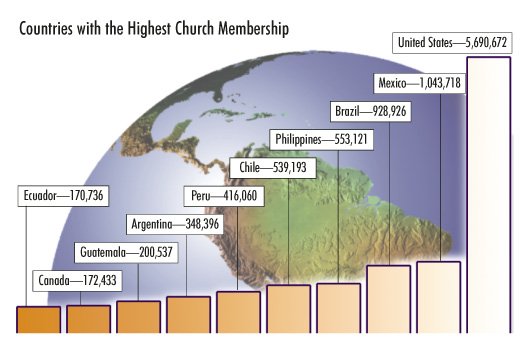 Both these narratives have scriptural precedent, and both have high ranking leaders on record stating this is how it will go down. And yet, both can’t be simultaneously true unless we convert a bunch of people who then fall away, which obviously can and does happen, but the falling away negates the first narrative.
My friend’s view was that these two narratives mean that no matter whether the church grows or shrinks, the church can claim it predicted it correctly. As I think about it, that view is probably one of a few possible ways of looking at these two competing narratives:
- The House Always Wins. My friend’s assessment is that the church has its bases covered so that no matter whether it grows or shrinks, that movement is “proof” of the church’s rightness.
- Plan A, Plan B. This is perhaps my alternate version of the first theory. In this version, our obvious Plan A is that we grow. But if that doesn’t work out, Plan B is that we blame those who reject this glad message. As a small business owner trying to grow to the point of profitability, I can attest that this is a time-honored strategy.
- Glass is Half Empty / Half Full. Another possibility is simply that some individuals have a more optimistic view of the world and others have a more pessimistic view. Some view the world as future church members, seekers of truth who haven’t yet found it, while others see the world as full of temptations, snares, and lacking moral values. Some are universalists while others are elitists.
- Statistics differ depending on time frames and comparison points. Either narrative can be accurate if you run the stats that way. Don’t like the growth trend? Go back further in time, starting with 6 members in 1830. Don’t feel we are adding enough convert baptisms each year? Instead show the number of missionaries serving!
What do you think?
- Which of these narratives do you hear more often? Which do you think is the current approach?
- Why do you think we sometimes hear both these narratives?
- Which do you see actually happening or do you see neither? What’s your prediction?
Discuss.
 Wheat & Tares
I certainly have heard both and I don’t remember a time where I wasn’t hearing both. Much more emphasis on the first back a few decades when the church was increasing quickly. Now a bit more emphasis on the “refining”.
I do have concerns over millennials and how they generally hold contrary views on some of the churches positions. I know all of my kids basically told me “The POX is stupid. Why did they do that?” I have read the stats on the latest Pew poll back a few years ago and if the current trend continues, within the US we may drop below 50% retention of youth going into adulthood. With baptisms tapering off (even with a ton more missionaries) the trend does not look good in the US.
I both predict and fear the refining scenario. I fear it because in my mind it means the church will become more and more conservative, controlling, and see everything as “us against everyone else that is possessed by the devil.” I fear we head more towards what the FLDS looks like. That scares me.
Among people who are paying attention, which are relatively few out here, I hear 1, 2, and 4. My own view is that I am much more worried about my own success, and that of my children, than about that of the Church as a whole. 16 million, 3 million, 4 billion, or 6, as long as I’m one of them, I’m OK. To the rational observer, growth is not an indication of righteousness, or we’d all become Catholics or Muslims. (I guess that puts me in Camp #1, but then I’m a believer.)
I share the fear of Happy Hubby, but not because I fear the refining – I believe that tends to be personal. I fear the idea of church leadership forcing some sort of ersatz “refining” on all of us, which no Latter-day Saint with a sound understanding of agency and gospel principles could in good conscience tolerate.
15 million divided by 7 billion = 0.2% living who were ever baptized or 0.07% of the earth’s population is currently active and opening China is the answer to continued growth??? This is rolling forth to fill the whole earth? I don’t think so! The product needs to be reviewed with the goal of making it more user friendly and inclusive without loosing it’s divine essence, it has become an exclusive club designed for conservatives in a world overwhelming populated by the poor.
One of the challenges with mormonism is that you can find directly contradictory statements on almost any issue/prophecy/doctrine.
This one example you have given of what is the prophetic future of the church is a great example of many, many, many other exact same issues.
Sadly it comes down to what do you want to believe more than what is real and true.
As you so eloquently stated, “Both these narratives have scriptural precedent, and both have high ranking leaders on record stating this is how it will go down.”
This is why personal inspiration and integrity to your own moral code is so important. Those within the boundaries of mormonism can easily pull you to one side or another of an issue and both can be totally justified with their cherry picked scriptures and quotes from General Authorities in general conference. They will both even bombard you with statements like “doctrine never changes”, while both sides are quoting diametrically opposed doctrinal quotes.
Great example of one of the key challenges within mormonism today.
James – that is oh so true as there are innumerable contradictions. The one that used to get under my skin was how many items should be “one or the most important” item/commandment/belief. The more analytical (and managerial) side of me wants a prioritized list, not a whole bunch of “most important.”
I wonder if the top church leader see this and emphasize, “I living prophet trumps a deceased prophet” and also why they seem (at least in my mind) not really making doctrinal stands very often. I glance back at President Hinkley and what comes to mind is “6 B’s”. I am not sure there is much risk to a future prophet coming along and overturning the “Be nice” admonition. The few places where they have made a stand the last few years is even causing issues within the ranks of the church (of course, that is just part of the “separating the ‘wheat from the tares'” – scenario #2).
This reminds me of the old Rabbi who when a member told him his view of the Bible, he said, “That’s true.” Then a second member told him her view of the Bible, he said, “That’s true too.” At which point a third member proclaimed, “But the two views contradict each other! They can’t both be right!” To that, he said, “That’s also true.”
And they lived happily ever after.
I see the contradiction, but don’t think it is irreconciliable. God has a way of reconciling apparently divergent viewpoints (e.g. Jesus will come from Bethlehem/Egypt/Galilee).
Here’s a small-scale example: Four missionaries, two obedient/hard-working, the others not. The mission president will pair each “good” elder with a less-effective missionary and ends up with two less effective companionships. But, if the two lazy/disobedient elders were sent home, then the two committed elders could be paired up and he ends up with a really effective companionship.
Obviously, this analogy breaks down at some point, but the paradox is that separating the wheat from the tares could be what allows the church to achieve an unprecedented level of growth.
My question is: “Does gospel = church = kingdom of God?”
In the example of the stone cut out of the mountain without hands, kingdoms were toppled. Neither Gandhi nor MLK were Mormons baptizing people into church membership, yet they crushed the power of kingdoms in a way no earthly power could, by becoming examples of pure religion. (Think “do what is right, let the consequence follow”.)
People resonate with truth, even if they are not inclined to live it in opposition to the prevailing culture and long-standing habits. As the tide of popular belief shifts, the culture eventually turns as well. For example, many people embrace health patterns consistent with the Word of Wisdom without reading the scriptures, or desiring membership in the Mormon church. Ideas of gender and racial equality have followed this same path.
As for the second scenario, I want to point out that the text related to the elect being deceived is preceded by the phrase, “if it were possible”. The question then becomes who are the “elect”? The church has been compared to a net gathering fishes of all types. Within the church there may various quality of fish, as well as wolves mixed with sheep. The parables talk of wheat growing with tares until the angels reap the field. It may be possible that as the world adopts a degree of truth, the church also adopts errors that mirror the culture and traditions of the members. That is why the scriptures warn us to both “watch” and “treasure up my word”.
One final thought is “in my Father’s house there are many mansions”. The idea of an expanding, all-encompassing kingdom may not be at odds with a select few who attain exalted rewards for extraordinary service.
The test of a first-rate intelligence is the ability to hold two opposed ideas in mind at the same time and still retain the ability to function.
F. Scott Fitzgerald
* * *
If a Jew has no one to quarrel with, he quarrels with God, and we call it theology; or he quarrels with himself, and we call it psychology. Or he quarrels with the psychoanalyst, and we call it literature.
Two Jews and three opinions are better that three Jews with no opinions. Passionate arguments are better than passionless acceptance.
– Elie Wiesel
* * *
As LDS we need to normalize Fitzgerald’s “cognitive dissonance,” as well as allow for Jewish-like passionate discussions. Alas, we can only really do this in social media such as this blog. In contrast, demureness, conformity and deference to authority are effectively required at our church meetings.
Jeff–I liked your comment.
I hear both narratives depending on the context of the conversation. When missionary work is being discussed, I hear the growth narrative with frequent citing of statistics such as the graph you share in figure one used to justify the massive push/lowering ages of that program. In other contexts, like Sunday school lessons where the teacher and members are trying to expound upon their Mormon awesomeness, I hear the whole “peculiar people” line (which is really the falsely humble Mormon way of saying “chosen people”) and then references to the second graph you provide.
Both narratives make me uncomfortable, in part precisely because they are so obviously self-serving. If one needs to use statistics to create any number of justifying narratives, one probably isn’t remotely as faithful as one appears. I really like Ranae’s many mansions comment. I’ve actually always read the small percentage of Mormons in a counter-intuitive way: Most people are better served (in getting closer to god) through catholicism, Islam and Buddhism and it’s the peculiar (NOT “chosen”, but peculiar the way Webster’s defines it) folks who need something different to get them there, hence Mormonism and its various splinter groups. So IMHO, we’ve got a different theology because we need something even more radical in order to get us where we need to go, not because we’re so awesome and special. Not to offend anyone, but just for example, the way Buddhism talks about ethics in the world and the cessation of desire is far more profound than anything we offer.
And Happy Hubby, you’re on a roll with your comments lately. I, too, fear the fact that Mormons seem to want to create fear. Fear of the other (whatever that might represent to folks), fear of anything different, fear of diversity, of new and challenging and potentially faith-promoting ideas, etc. Note that the “peculiar people/there aren’t many of us so were special” viewpoint has very much to do with fear, I think. Honestly, I don’t see Mormonism thriving at all in the coming century unless some radical changes are made relatively quickly, which, given our history, isn’t terribly likely.
I hear number one more often. Elder Holland recently said the biggest problem we have in the Church is it’s growth. I don’t think that is true but it goes with that thinking. I sometimes do hear two as well. I tend to hear this one from members who think they are the elect and don’t like groups such as LGBT, ordain women,etc, who they see as troublemakers and should be purged from the ranks.
I personally think the Church has become a major business corporation that will fill the earth in that manner in spite of it’s doctrine instead of “because” of it. In fact, it’s theology is becoming very bland except the homophobia that exists.
There is the old story of parents who, before sonograms existed, asked the OB what gender their baby is going to be. The doctor says “A Boy”. But the doctor writes “A Girl” on the chart.
If the couple has a boy, they think the doctor was brilliant and got it right. If the baby is a girl, the parents come back to tell the doctor that he got it wrong. The doctor can then open up the chart, and show them the notation that very plainly states “A Girl”. The doctor can then tell the parents that they simply misunderstood his words.
Much in the church is handled like that OB handled gender and babies.
A vet friend of mine said “If you are asked to sex a bird, always say female. That way, if it lays an egg, you’re covered.”
I think most Mormons try to reconcile these two by having the church first be small (before the Millennium) and then be big (after the Millennium).
Going along with Nate’s comment, I still hear scenario number 1 quite often, but in my adult life (last 16 years or so), it’s emphasized that most of this growth happens after the millennium, which, aside from an absence of extreme evil and an arrival of a world in a terrestrial state, still, in my opinion, will be fairly similar to how we are now.
It was my mission president that pointed out to me that Nephi mentioned that the Saints ” . . . were few.” at the time of the Savior’s 2nd coming. I’d never noticed that before. If we’re talking “few” in strict Biblical terms, I like to optimistically think about 1 in 8 people will be LDS when the Lord returns, but who knows.
I see scenario 2 as a short term thing, although I think it could go in spurts over the next few decades. I served my mission in Scandinavia, and some Saints still speak of a “Second Harvest.” Area authorities did nothing to lessen that talk, but emphasized it would only follow hard work. I suppose the same goes for anywhere else in the world.
Jeff G says (#6): This reminds me of the old Rabbi who when a member told him his view of the Bible, he said, “That’s true.” Then a second member told him her view of the Bible, he said, “That’s true too.” At which point a third member proclaimed, “But the two views contradict each other! They can’t both be right!” To that, he said, “That’s also true.”
This is an essential feature, not a bug, of Judaism. Jacob’s wrestle with God is a metaphor, not only for our earthly struggle, but for Jewish theology.
It is also, or should be, a metaphor for LDS theology. My reading in LDS history and theology during my early years in the Church, say late ’80s-early ’90s, led me to believe that it largely was, at least historically. Joseph Smith certainly seemed to see it that way, which is one of the many things I admire about him. But at some point in the intervening 30 years, I think we decided to “make friends with the mammon of unrighteousness” – to suck up to the American evangelical right – and so to some extent we, as a church and as a people, have begun to adopt their rigid sense of Biblical literalism and apply it to everything. Biblical infallibility and sufficiency are ludicrous theological positions to hold, and the spillover to LDS culture is positively toxic. (The idea that we’re fawning over the same people who have been our primary persecutors for the better part of two centuries, and whose basic feelings toward us hasn’t changed a whit since Haun’s Mill, is an entirely different can of worms.)
Ranae asks (#8): My question is: “Does gospel = church = kingdom of God?”
Emphatically no. In fact, I’ve known people who have gone through horrible times at church. Some have stayed faithful, some have left. It depended on whether or not their testimony was in the church or in the Gospel. It’s critical that we all do our best to understand the difference, and that we don’t take every random utterance by a church leader as a Directive From God(TM). If President Monson uses Crest, that does not mean that Crest is God’s toothpaste.
I must be really out of it. POX. What does this signify? I have wracked my brain trying to divine which policy or procedure young people could/would consider stupid. I made a full-page list two columns across and couldn’t come up with it. Please help my unawareness–
Pox = Policy of Exclusion = Nov 5th Policy
Sorry. POX is short hand for the policy change in the church handbook of instructions book 1 (bishops, stake presidents, and above) that occurred last November dealing with gay marriage and the children of such marriages. It has been called the “Policy Of eXclusion” in some circles as it excludes children of same sex marriages from normal baptism, priesthood and missionary service.
I should have not used the abbreviation without describing it more. Thanks for asking so other will know and I will remember not to abbreviate. I work in IT and we by nature make an acronym out of EVERYTHING!
Roger, you might want to participate in our online poll about the POX: http://www.wheatandtares.org/21882/your-opinion-on-pox/
It seems like the narratives are only going to mean something if church statistics are the measure of success.
Do either narrative work if the church grows in numbers of hypocrites or people just wanting welfare? If the church membership keeps going up but he quality of church influence in people’s lives goes down?
Or what if the world becomes less wicked and sinful and starts to progress society as a whole and people find ways to live the gospel outside of church membership? What if the church membership goes down, and those that are remaining in the church are the less valiant ones, that only cling to literal teachings and do not open their eyes to the gospel message, or live isolationish and sheltered lives? Is that membership number going down in the church a given that they are all “more valiant”?
The narratives only could work if you believe membership statistics in the church is the measure of true gospel living, and the world is all a sea of sin. Us vs them. Black vs. white. All those who are good stay in the church, all those who leave are wicked and darkened by the devil.
Something tells me that graphs and statistics can’t capture how the Lord looketh upon the heart to judge sheep vs goats.
Remember he was talking to church members when he said in 3NE 14:21-23 “Not every one that saith unto me, Lord Lord, shall enter into the Kingdom of heaven; but he that doeth the will of my Father who is in heaven. Many will say in that day:Lord, Lord, have we not prohpheside in thy name, and in thy name cast out devils, and in they name done many wonderful works? And then will I profess unto them: I never knew you; depart from me, ye that work iniquity.”
Perhaps that is the 3rd narrative…
“We don’t need church statistics to prove that God will win in the end. As for me and my house, we will serve the Lord…regardless of statistics to back it up.”
Truth rolls forward in the hearts of people. Church is there to help, but is not the measure of righteousness only.
Thank you, HH. Perhaps due to the vissisitudes of age or merely the buffetings of the Adversary I couldn’t come up with this–
I had an idea that this policy was likely the subject at hand. Out on the borderlands, it’s difficult to summon sustained distress over what the moguls do–
Hey that’s me! It was a great discussion and its great to see it in the format!
Also, another thing we humans, as organization-joining social organisms, tend to miss is this: “success” is personal. The church can rise or fall, grow or shrink, prosper or falter, but I personally have everything I need to be exalted. If I fail to achieve that, it’s on me. The church can be and should be a great help, and it has given me the tools, but it’s up to me.
Like others, I tend to hear the first narrative in the context of missionary work, especially when countries are opening up to proselyting efforts. I hear the second narrative more often right now in private conversations and weekly church services. In fact, a sales lady at Deseret Book just talked to me about church elect being deceived last week. I question the sales technique since I was purchasing Hales’ “A Reason for Faith,” but I think she saw the book and decided to talk about her friend’s son leaving the church over historical issues.
Attention: China has already opened up. But we narrow-minded navel-gazing Mormons sort of missed the boat because China doesn’t fit our missionary model.
Basically the current LDS foreign mission model developed after WWII. We follow the American flag with diplomatic permission obtained first by high ranking leaders, then establishment of mission homes with a mission president. Only then do the teenage “Elders” show up in small or large herds and the baptisms accumulate in small or large numbers while the retention generally is lousy but not zero.
Not happening in China. Technically Christianity is illegal in China with three minor exceptions. They are not about to give a right-leaning LDS church with a history of rabid anti-communism (thank you ET Benson et. al.) permission to do much of anything. So we have been patiently waiting and praying for a time when our missionaries will officially be allowed while a few missionaries wander a few miles from Hong Kong and pretend to be opening up China. If Jon Huntsman as President Obama’s ambassador could not open up China for us who else will?
Evangelicals have been operating underground in China for decades now with remarkable success. (Actually since the 7th century but Mao wiped out most of any previous progress). It is hard to describe what they do because it is secretive, by-the-seat-of-the-pants, and highly variable. One example is a violin teacher we supported who got hired to teach music and English in China. She smuggled two of her three suit cases full of Bibles (which could get her sent to prison) and started a small house church of her several converts and then joined up with others. The living conditions were rather harsh and she had to come home after a couple of years.
My son wanted to serve a mission in China ever since he was a child because he likes panda bears. He did not serve a traditional LDS mission but he graduated from college with a degree in a scientific field and was able to spend two summers in Beijing teaching at the university level and meeting with Christians and quietly converting dozens of people to Christ, not to the LDS church. Few if any native LDS members live permanently in this huge city although a few dozen foreign non-permanent Mormons do gather. Millions of underground native Chinese Christian converts do live and quietly practice their religion there. I hope my son doesn’t get too attached to this work because there is no official release date built into it.
I won’t say he (who had 850 nights of camping as a boy scout) was involved in this. But there are people in China who smuggle North Koreans out of China. Either into Mongolia or Thailand. At times it is not difficult for people to cross the Yalu river into China, especially young women destined for the slavery of the Chinese sex industry. This rescue mission is extremely risky and often includes real treks through remote mountains and deserts in extreme conditions with people who have no camping/hiking/mountaineering skills. (Shades of Wille & Martin companies?) What groups in China might have the courage and the altruistic motivation to not exploit helpless young women and risk live and liberty to do this? Not us. Recipients of this kindness might be expected to have what level of appreciation and commitment to a new religion?
Last spring a certain young man did take me on a hike closer to home covering 62 miles and multiple climbs of a few thousand feet in two days just for “fun.” What was he thinking?
The results of this missionary work in China are not known and not reported by the government. But those who have served there think the numbers are high, as many as 10% of 1.357 billion which could be well over 100 million new Christians in China. Probably more than the total number of practicing and believing Christians in Western Europe. They are neither Catholic nor Protestant for the most part. They have no leadership or governing bodies (for the authorities to punish) to issue creeds and direct beliefs and write handbooks. They are somewhat of a heterogenous syncretic religion retaining elements of the native Chinese religious ideas of Buddhism, Taoism, Confucianism, and of course foreign Marxism, etc.
Thoughtful people might consider that in some ways we are headed for war with China as our national interests increasing collide. The best way to avoid this descend into the next dark age (when religions like Mormonism will likely be eliminated) is for people like my son to go there and build personal ties and share understanding and information. And for their best and brightest to come here to study.
The early history of Christianity included a large central group of Jerusalem Christians and smaller groups of Pauline converts scattered around the Roman empire. But the central Jerusalem population was anniliated and the Pauline converts became the roots of the Christian church. A similar thing could happen and Chinese Christians may be the face of the new post WWIII Christians if this war happens and we lose it.
I think this might seem a bit far-fetched and tangential to the rest of the blog. But in the big picture it isn’t- think about it.
POX- Policy Of eXclusion. Referring specifically to the Nov 5th policy excluding children of same sex couples from being blessed, baptized, ordained to priesthood, participating in Temple baptisms etc.
@Mike, yes an old university friend of mine and her husband spent 16 years as Christians in China, as part of a mission – I mentioned it in this post (http://www.wheatandtares.org/12354/whats-in-a-mission/).